top of page

Updated: Nov 28

Pain Attacks. The first of a two-part “before-and-after” advertisement for Wolcott's Instant Pain Annihilator aka Wolcott’s Pain Paint. Created by: W. Endicott & Co., about 1863. Library of Congress; Museum No. LC-USZC2-36.
PAIN. Throbbing, stabbing, aching, distracting, excruciating, agonizing, unbearable PAIN.

Hannibal Lecter and S&M enthusiasts aside, most people don’t like pain. We’ll do just about anything we can to avoid it and when it does happen to us, we’ll do everything we can think of to get rid of it, as quickly as possible.

A toothache; a hangnail; a sprained ankle; a leg cramp; a migraine headache – every pain is one we want to have go away. You, me, and every one of our ancestors have tried almost everything to get rid of pain quickly. Sometimes what we try defies logic – and almost certainly flies in the face of science – but for thousands of years, in moments of excruciating pain, we have turned to methods and cures that win our praise if the pain goes away. That has often been the sole measure, whether it’s with two Advil pills today or a teaspoon of Wolcott’s Pain Paint over a century ago. When pain hits, our animal instinct just wants it to stop and the method, be it scientific or magical, really doesn’t matter. Be honest with yourself – you probably couldn’t explain the chemistry and active ingredients of Tylenol any better than your Victorian forebears could with Dr. William’s Pink Pills for Pale People.

      The image above shows a Victorian era man plagued by a legion of demons in full attack mode, causing his headaches, sinus pain, toothaches, neuralgia, and more. To his right, the Grim Reaper emerges from his fog-shrouded netherworld, looking pleased at the pain being inflicted by his minions. In the same primal way that such imagery symbolically described their pain, Victorians also wrapped their aching heads around the idea that pain could be cured by magic.

Bartmann Bottle, about 1650. At its base is a modern recreation of typical “witch bottle” contents: nails, a fabric heart pierced by bent pins, and human hair with fingernail clippings. Rapoza collection.
      Such a belief was likely passed down to them by old-timers in their lives who insisted that a special home-made medicine had to be swallowed during the waning of the moon or who still hung a horseshoe on their door. My own grandmother winced as she told me how her grandfather made his own medicinal tea from rat droppings because he distrusted doctors so much; he may have thought it was a magical brew but my grandmother thought he was full of crap.

      America has a long history of reliance on magic and superstition to influence our behavior. Today’s post offers just a few examples for you to steep in your cauldron of possibilities for the next time your body screams at you, “I’M IN PAIN!”
     
Colonial Magic

As I shared with you in my post, “Weaponized Witch Bottles” (10 AUG 2024), colonists in North America relied on biblical passages that warned against the evils of witchcraft. They turned their empty wine and beer jugs into weapons to protect against the attacks of witches and their familiars, especially to protect the sick in their families. They further strengthened their defenses by hanging a horseshoe outside their door and making ritual protection marks around their doors, windows, and fireplaces – all the possible entry points for evil spirits to enter the home. Even biblically-inspired numerology was taken seriously: a braid of 12 garlic bulbs (symbolic of the 12 apostles) hanging behind the door was believed to prevent witches from entering the house; just 11 bulbs was nothing more than a bunch of smelly vegetables hanging on the door.

It was a time when magic was medicine and superstition dominated in the absence of science.
 
Victorian Magic

      Two hundred years after the Salem witch trials, well after the colonies had merged into the United States of America, the country had survived its Civil War and two wars with England, and it leapfrogged into an era of electricity, telephones, x-rays, anesthesia, vaccines, blood transfusions, and the discovery that germs cause disease. Amid all this growth, modernization, and sophistication, it might seem like there was no longer a need for superstition and magic.
Magical Medicine from the Mystical Kingdom. The Egyptian theme of Colwell's medicine tied in perfectly with its promise of magic. The eye-catching trademark featured the bizarre Sphinx above and baffling Egyptian heiroglyphics flanking the word MAGIC. The Egyptian-inspired trademark hinted at the mysterious origins of the magical cure. There was absolutely no effort to ensure scientific efficacy. (Library of Congress: Trade Mark No. 10,302, registered 22 MAY 1883)

If that’s what you’d choose to believe, you have chosen … poorly.

      Pain and disease had not been eliminated and science and medicine still had a long way to go. People were still having headaches and toothaches, rheumatism and sprains, and a bottle or box of medicine still offered low-cost, high-promise alternatives to doctors and dentists. 

      The absence of regulation in the medical marketplace meant medicine makers didn’t have to reveal the contents of their products and it’s fascinating how often they chose to claim their cure was  MAGIC – far too many to list them all here, but a few examples were:

  • Bennet’s Magic Cure
  • Dr. Colwell’s Magic Egyptian Oil
  • Fink’s Magic Oil
  • Van’s Magic Oil – None other than a customer named Mrs. A. Pain wrote to the manufacturer, “We will never employ a doctor for cold or diphtheria while we can get your Magic Oil.”
  • Dr. Horbson's Magic Oil
  • Dalley’s Magical Pain Extractor
  • Dr. Hardy’s Magical Pain Destroyer
 
Dr. Hardy's Magical Pain Destroyer (box & bottle), about 1885. It's hard to believe that Dr. Hardy's brooding face could encourage any confidence in the success of his medicine. It was likely a rendering from some early form of photography that required expressionless faces so the result of the slow shutter speed would not be fuzzy. But come on, Dr. Hardy - crack a smile! It's not magic! Courtesy of Sheaff-Ephemera.com
Dr. Hardy's Magical Pain Destroyer (label on interior counter display box lid), about 1885. Courtesy of Sheaff-Ephemera.com

      One look below at the Victorian poster for Renne’s Pain Killing Magic Oil vividly reminds us of how much we hate to hurt. His puffy eyes are almost squeezed shut; a large tear streams out of the corner; his lips look aquiver in misery. The head bandage under his jaw was usually a symbol of tooth pain, but this pathetic soul is also holding his stomach, apparently yet another locus of pain. We empathize with our young friend – we feel his pain.

      Miserable in pain and apparent low on funds with a patched and tattered jacket, the young chap stands dumfounded in front of a drug store full of Renne’s Pain Killing Magic Oil; it’s frankly hard to tell if we are supposed to be witnessing that magical moment when he realized he had just found the cure for his woes or if his tear is because he couldn’t afford to buy the magical painkiller. Either way, he clearly wants some magic in his hard-luck life.

Renne's Pain Killing Magic Oil (bottle & poster, about 1885). Bottle courtesy of Library of Congress. Poster courtesy of Wm Morford Antiques, AntiqueAdvertising.com

      Notice that on the bottle, above the picture of Mr. Renne, was the magical medicine’s slogan, “IT WORKS LIKE A CHARM”; some newspaper ads for assured that its effect was “very magical.” It was, of course, a great word to hide behind, since the public were not invited to know the ingredients and proportions being used in the medicine. Medicines not promising magical results hid behind other fanciful names, such as Dr. Kilmer’s Swamp Root Kidney, Liver, & Bladder Cure, Pocahontas Barrel Bitters, and Smith’s Bile Beans. But “Magic” was more than a just camouflage; it was also a promise of potency and results even though sick customers had no idea why it would work for them. Subconsciously, people who enjoy magic shows want to be deceived. It fills us with wonder and awe and lets us believe that the world is full of unexplainable things. Magic gives us hope there are answers for problems and pains we could not solve ourselves.

      Anyone who collects antique medicines knows that patent medicines had all sorts of names; those promising to stop pain weren’t limited to names implying magical ingredients. Perhaps the biggest selling pain cure of the century was the magic-free Perry Davis’ Pain Killer. Another example is from my own collection, Thurston’s XXX Death to Pain. Not only did its name promise to be the death of pain, but the triple “X” meant triple-strength – no indication of what, but it certainly sounded powerful!

Thurston's XXX Death to Pain (box & bottle, about 1890). Rapoza collection

      Similar to the magic cures was a smaller subset of medicines called “mystic”. The name of Dr. I. A. Detchon’s Mystic Cure made it clear that the contents transcended human understanding and were somehow connected to ancient and perhaps occult mysteries. One of its ads explained that “Its action upon the system is remarkable and mysterious.” - take it, just don’t try to understand it.

      Note that the bottle label explains that the Mystic Cure should only be used in combination with the Mystic Life Renewer.

Detchon's Mystic Cure (box & bottle, about 1885). Rapoza collection.

Newspaper advertisement for Mrs. Wilson's Mystic Pills by the Gray Medicine Co., Toronto, Canada.The Daily Expositor (Brantford, Ontario), 2 OCT 1880.
      Mrs. Wilson’s Mystic Pills from Toronto, Canada, was the perfect name for a medicine designed for the many diseases and disfunctions of the mysterious female reproductive system. The title implied secrecy, the dark closet in which many high-strung Victorians wanted to have the subject hidden. The trademark shows the female angel holding a box of the medicine in her right hand and her left hand pointing to the banner that displayed the “Mystic Pills” part of the name. An enlargement of the knuckles actually suggests the angel may be using the middle finger, but let’s just say it's the index finger!

      For at least some of the many late-19th century remedies, the evocative words “Magic,” “Magical,” “Mystic,” or “Mystical,” in their name were used as more than just convenient marketing adjectives; they were designed to attract those customers who continued to harbor the centuries-old beliefs in magical potions, hoodoo, astrology, charms, and promises of good luck and fortune. The reason so many medicines seemed magical in their result was most likely due to the active ingredient (besides alcohol): opium, morphine, cocaine, or cannabis - they were each dangerous in excess but truly potent and successful in temporarily diminishing or eliminating pain.

Columbia believes in Magic. This Civil War-era newspaper advertisement for Weeks' Magic Compound invokes the patriotism of Columbia herself. The manufacturer was E. B. Magoon & Co. of North Troy, VT, 1862.
      Of course each era has also had its critics. Just like there were colonists who insisted there was no such thing as witchcraft, magic and mysticism had its detractors in the Victoria era. In 1900, Missouri’s Joplin News-Herald complained bitterly that “Americans are still believers in magic …” The newspaper pointed to a single factory of “magical devices” and found that it produced crystal balls and “not less than 5,000 divining rods and many other similar contrivances which are supposed to have the virtue of locating gold mines or hidden treasure.” – and the newspaper was disgusted that gullible fools would spend their money on things supposedly imbued with magic:

For one of these treasure indicators a farmer will pay from $15 to $35, and then, neglecting his toil, firm in the conviction that he has a truly magical device that will bring him untold wealth, he will tramp for days and even weeks over the old fields he had farmed since boyhood, seeking the gold mines and buried treasure the “magician” has assured him is there.

      Medicines made in the name of “Magic” were another clear evidence of a portion of the population still hanging on to remedies emanating from the occult universe. In fact, even as the new Food and Drug Administration clamped down on specious patent medicines, magic oils and the like lingered, defiantly, deep into the 20th century.
     
Digital Magic

      So now, dear readers, we sit in front of the screens of our cell phones and computers, reflecting a little smugly at the centuries of Americans who have believed in and resorted to magic, luck, and the mystical. But while our country may have continued its forward march in medicine, science, and technology, we are clearly far from giving up our superstitions and symbolic acts for warding off evil, eliminating physical and emotional pain, and encouraging good “mojo.”

      Many doctors still administer placebos and patients often believe those harmless pills have made them feel better. Copper bracelets have never been proven to improve health, but many swear by them, nonetheless. (No offense intended to the placebo or copper bracelet manufacturers.) Family, friends, co-workers, and sometimes even strangers will say “bless you” after you sneeze, to ward off illness. And lots of Americans still act out in similarly irrational behavior today to improve, protect, and bring comfort to other areas of their lives in the midst of an often harsh and painful world:

  • Since 1952, fans of the NHL hockey team, the Detroit Red Wings, have thrown a dead octopus on the ice for “good luck” in the playoffs, despite the fact that the team has won only 7 Stanley Cups in the 73 years that octopi carcasses have slid across the Detroit ice. Oh, and catfish are similarly tossed onto the ice to invoke good luck for the Nashville team, and plastic rats keep getting flung into a hockey rink just north of Miami after a player killed a rat in the locker room with his hockey stick before the game and then scored two goals with that stick.

  • After you eat your Chinese food, do you throw away the fortune cookie or do you open it to see what the fortune says? (… And does the rare fortune that promises, “Great wealth is coming your way,” get quietly tucked into your pocket?)

  • Do you save the turkey wishbone to engage in a little post-Thanksgiving tugging match for luck?

  • Have you noticed that tall buildings usually have no 13th floor selection in the elevator? The architects and engineers didn’t forget how to count.

  • For the last 51 years, Lucky Charms cereal has featured marshmallow bits in the shape of such luck-laden symbols as blue moons, four-leaf clovers, and horseshoes. (My guess is that witches can’t eat that cereal.)

      We may not have been comfortable living in Colonial or Victorian America, but they would probably feel right at home in home here. Our modern world might be full of advanced knowledge but pain still haunts us all and hope for magical improvements still ripple through our souls.

Pain Vanquished. This is the second of a two-part “before-and-after” advertisement for Wolcott's Instant Pain Annihilator aka Wolcott’s Pain Paint. Created by: W. Endicott & Co., about 1863. Courtesy Library of Congress; Museum No. LC-USZC2-36.


How much was too much for a new life?
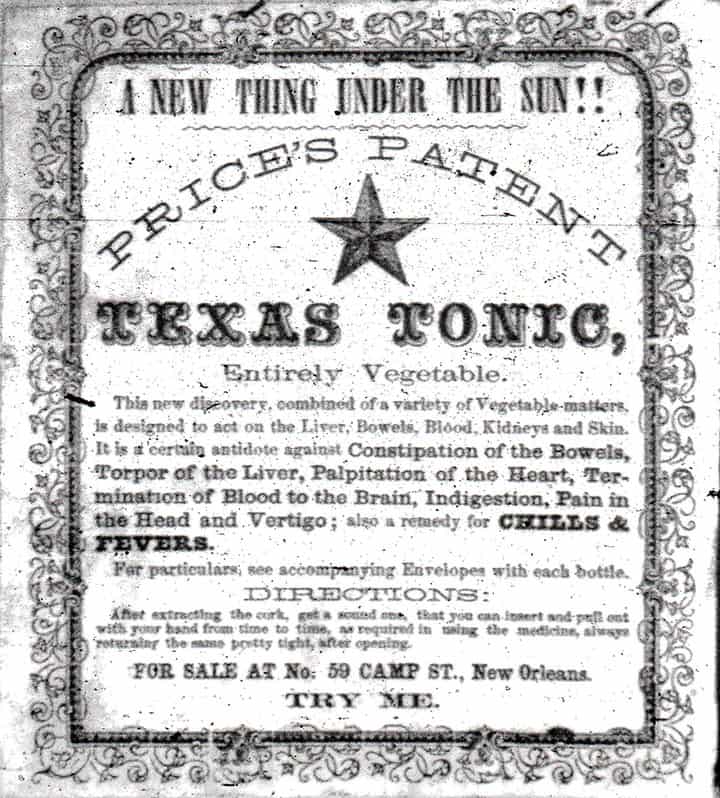
"A New Thing Under The Sun": front bottle label for Price's Patent Texas Tonic, ca.1845. (Courtesy of PeachridgeGlass.com)

To the best of my knowledge, there is only one bottle from the era of the Republic of Texas (1836-1845) that actually has the name of that short-lived country embossed on it. PeachridgeGlass.com states that only three examples still exist, and I have recently had the privilege of holding one of those three treasures in my hands. I thought I could make a worthwhile contribution to history and the bottle-collecting hobby by researching and writing about Price’s Patent Texas Tonic. The results? A web of patent medicine connections between a war hero, governors and ministers, slaves and  plantations, Mormons at Nauvoo, Transylvania University, and the infertility of a U.S. president. I came to realize that probably only three examples of this old glass bottle still exist because the others burst at the seams with the explosive story they tried to hold inside.

Opportunity Knocks

The year 1840 was a hopeful, fearful, profitable, risky time to be in the Republic of Texas. The continent’s newest country had come into existence just four years earlier when the far superior, better equipped, professional army of General Antonio López de Santa Anna had been soundly defeated by a ragtag assemblage of untrained volunteers under Sam Houston. Suddenly, the northeast borderlands of Mexico had become the Republic of Texas, where land was cheap and plentiful, and opportunity was as big as the Texas sky.
Map of the Republic of Texas, ca.1837. The area under control is in pink; the area disputed by Mexico and Texas is outlined in a solid red line; the disputed area included what today comprise sections of Kansas, Oklahoma, New Mexico, Colorado, and Wyoming. McConnell's historical maps of the United states (Courtesy of the Library of Congress, Geography and Map Division).
Even with the challenges of continued Mexican raids, Comanche, Kiowa, and Apache attacks,  a lack of roads and mail service, and a seasonal rotation of epidemics, the opportunities proved irresistible to the many arriving from the U.S. and Europe. The defiant taunt that had been stitched into the Texian flag at the start of the revolution could have been willfully misread by the new wave of opportunistic invaders as a friendly invitation: "Come and Take It".

The Merchant Prince

No one heard the siren call of opportunity in Texas more than a certain middle-aged merchant of Nashville, Tennessee. His name was John Price and he was all about the money. It was how he measured his house, his business, and even his family. Born in 1790, some of his values were formed in his childhood: his mother was a devout Methodist and his father was a slaveowner. He was remembered as an eccentric man but shrewd, fond of Methodist camp meetings and a zealous participant in revivals. Deeply involved in Nashville’s Methodist church, he was a manager of its missionary society and bible society, as well as the county temperance society.

In 1814 at age 24, he married the daughter of a Methodist preacher whose family were said to also be quite wealthy. From the time of his first marriage and into the 1820s, John Price was already one of Nashville’s elite, a slave-owning merchant, selling virtually anything for a profit and renting out houses and warehouses for still more gain. His advertisements listed for sale or barter everything from 19,000 pounds of pig lead, 400 pounds of cotton, 40 hogsheads of tobacco, 100 barrels of pecans, and 500 bags of salt to Kentucky Whiskey, Virginia tobacco, Jamaican rum, and peach brandy. His ads were also found selling sugar, coffee, and bacon, a large work horse, anvils and vises, and cooking and parlor stoves. His strong support of Methodism was clearly a strong motivation behind him also selling a popular Methodist book, Adam Clarke’s Commentary on the Bible, and he got his first taste of promoting and selling medicines with Lorenzo Dow’s Family Medicine, the product offered by the eccentric, unorthodox, and zealous traveling Methodist preacher who was widely known as “Crazy Dow.” His first ad for Dow’s medicine in 1828 listed the he had an inventory of 3 dozen bottles along with the hogsheads of tobacco and the barrels of pecans; a year later he still had a few bottles of the stuff left and tried to get rid of them by bluntly pushing,

“LO OK– DOW! –Save yourselves from sickness and death.”

Not only had John Price made the effort to help out the Methodist preacher, but his wealth and reputation seemed to have helped him establish connections with some of Nashville’s favorite sons, like Sam Houston, who became governor of Tennessee and later the Republic of Texas, and James K. Polk, who became President of the United States. There’s no evidence that John Price sought elective office, but he may have risen from a merchant to a merchant prince had he stayed in Nashville long enough.
Five-Dollar Bill, Republic of Texas Currency, ca.1840. Five dollars was all the money John Solomon Fullmer had when he arrived in Nashville, not nearly enough to get permission to marry the daughter of John Price; it was, however, enough to buy a bottle of his Texas Tonic. (Courtesy of CABANISS CURRENCY).
Father Knows Best

The wealth and luxury he was busy accumulating provided more than just a birthright for his children to enjoy; it was a social status they were expected to maintain. They grew up with servants and houseslaves, a handsome home and fine clothes, and received the best education money could buy, but they were forbidden to marry beneath their station. John’s oldest daughter, Mary Ann Price, was a perfect example of her father’s formula for success. She was his oldest child and never had to experience need or hardship. She had her own maid and a private tutor and she graduated from the Female Academy of Nashville. But then she went and fell in love with the wrong guy.

Mary Ann had turned 21 in September 1836; in the eyes of the law that made her an adult who could choose the man she wanted to marry – but not in her father’s eyes. The man she loved was John Solomon Fullmer; he had some education, worked hard at a newspaper, and showed entrepreneurial promise but he had arrived in Nashville a few years earlier with “a five-dollar bill in his pocket … without friends … and no training in a trade” – not at all good enough to marry a daughter of John Price. His marriage proposal having been rejected by the obedient daughter, the embittered beau put all the blame on the “wicked and avaricious heart … of Old John Price”:

… Mary’s reject[ed] me, solely for her father's sake … I have abundant evidence that she loves me still, and that she would still marry me if she were not prevented by her father; but without his consent she would not marry any man living.

The young lovers went off and eloped in May 1837 and her father never forgave her. About two decades later, another daughter of John Price married the man who had been the fourth governor of Texas; it was exactly the kind of union John wanted for his children while the unprosperous newspaperman certainly was not – and Price’s relationship with his daughter and her unacceptable husband only went from bad to worse.

In February 1841, the son-in-law non grata wrote to John Price about how he had taken Mary Ann far away, “It was no doubt with great surprise that you first heard of our removing to Illinois." In 1839, Fullmer had gone to the Mormon colony at Nauvoo, Illinois, where he was baptized by their founder and prophet, Joseph Smith. He then returned to Nashville to gather Mary Ann, their child, and possessions to move and join the Nauvoo colony. John Price was incensed at the planned move and offered Mary Ann a restoration of her wealth and social position if she would desert her husband and stay behind with their family in Nashville. Mary Ann refused and was consequently shunned by her father – she never saw her parents, siblings, or Nashville again.

John Price just moved on; while his forsaken daughter and her family moved over 400 miles northwest to Nauvoo, John took the rest of his family twice as far to Galveston, Texas. To him, his daughter’s departure was based on delusions while his was based on opportunity: he was certain she would pay for her choices, while he would earn for his.
Port of Galveston, ca.1845. Public domain book illustration, Library of Congress.
Making Money in Galveston

In March 1837, even before Mary Ann eloped, John Price was already preparing to move his family to the new Republic of Texas. He had entered into a business arrangement that apparently necessitated a substantial investment on his part.

In consequence of a recent compact entered into with a company of respectable gentlemen as their agent in the Republic of Texas … it is probable that myself and family will or may be required to move to the Republic. (emphasis added)

His preparation involved mortgaging his properties in Nashville and Columbia, Tennessee, and Huntsville, Alabama, to fund the relocation and business investment. It was a big move, a big investment, and a big opportunity. Three years later, early in 1840, the Price family, with the palpable absence of daughter Mary Ann, relocated to Galveston Island in the Republic of Texas. With a population of about 3,000 in 1840, the city of Galveston wasn’t even half the size of Nashville and it was dwarfed by New Orleans, which exceeded 100,000 but the tin island city was the front door of Texas; everything the new republic needed would have to pass through it. It was a merchant’s paradise.

The signature of John Price on a Galveston property document dated 6 November 1840. The letter "i" in the surname appears to be creatively dotted three times in sequence but it also could have been the result of a dripping pen trip.
John invested heavily in his new country; he purchased properties in Galveston, Jefferson, Crockett, Fort Bend, Sabine, and Bastrop counties, and city lots in Houston, Galveston, and Fort Houston – 11,262 acres in all by 1844. The Price family lived in a mansion on the north end of Galveston Island on Twelfth Street, between Church and Winnie Street. It fronted to the east towards the gulf; it was “one of the largest and most conspicuous residences in Galveston.” The family and mansion continued to be served by domestic slaves, starting with three under 15 and four adults upon their arrival in 1840, but settling for the next several years on one adult male, one adult female, and two children under 10. Some other items on which John Price was taxed included a gold watch, a silver watch, a saddle horse, and a “pleasure carriage.” He also became one of the founding members of the Methodist Church formed in Galveston and he purchased $100 in stock certificates ($3,600 in 2024 USD) that were designed to help reduce the Republic’s massive post-war debt. Just like in Nashville, John Price firmly entrenched himself in Galveston’s community, the church, his business enterprises, and his social station.
ree

Price also continued his work as a commission merchant, regularly receiving cargo from the sidewheel steam packets that came across the gulf to Galveston from New Orleans, like shipments of ice for which he advertised he would “keep a constant supply on hand for the accommodation and comfort of the citizens of Houston.” Supplying ice to Houston was as sure-fire as peddling ice cream in Hell – it was a guaranteed money-maker for the shrewd merchant.

He further invested his time and energies in inventing and patenting; John Price was one of the earliest residents of the new republic to get his ideas patented. In 1839, while still of Nashville, he had been granted U.S. patents on a cotton press (for compacting cotton into bales) and eleven days later for a burner of pine knots, providing a source of illumination long before the time of electricity. Over the following two years, as a resident of the Republic of Texas, he was granted some of the first patents the new republic issued. Two were for the inventions that he had been previously given U.S. patents; the other three were for a chimney, a mill-dam, and something he called a “Texas Tonic” – indisputably the first medicine patented in Texas. A cotton bailer, a chimney, a torch, a dam, and a medicine – his five inventions couldn’t have been more different from each other if he tried. He was remembered by one of his contemporaries for having original ideas – the variety of his inventions seems to have amply proved the point.
ree

“A New Thing Under the Sun”

Of his five inventions, Price’s Patent Texas Tonic was the only one that would require retail consumer interest to succeed; the other four were mainly of consequence for business and industrial applications, so his most visible investment of time and money was in the Texas Tonic.

The first advertisement found thus far, in the Civilian and Galveston Gazette of December 1846, featured the sunburst shown here and the slogan, “A New Thing Under the Sun.” He sold it at his business on the Strand in Galveston, the major commercial thoroughfare of the city and the entire region. Price told his newspaper audience to look for “the agency flag” there; that instruction, along with the street address and the sunburst image over the same ad, strongly suggests that the flag marking his business on the Strand was the sun graphic appearing in the ad. The bold image on a flag would indeed make his place easy to locate.

According to his advertising, the tonic bitters, as the back label called them, was first and foremost a cathartic – a powerful laxative that would clear out all the evil, disease-ridden gunk that clogs up a sick person’s internal plumbing, causing maladies from indigestion, constipation, and migraines to hemorrhoids, dizziness, and rheumatism. It also helped prevent the onset of the chills and fever, an enormous seasonal problem in the South. Testimonials appearing in his ads spoke most often of the tonic’s remedial effect on indigestion, chronic headache, constipation, and ague and fever. His ads also stated it was safe for children and “Peerless for females, in a delicate state,” meaning pregnant. Another important medicinal promise, presented in rhyming verse, was that it would cure infertility,

Barrenness.

Oh cheer up your spirits! don’t look so shy,
If husband’s ashamed, a servant can buy;
In three weeks or so! perhaps not so soon,
Gaze with delight on the beautiful moon;
Your eyes become bright – a heart filled with joy,
Good prospects in view – a Girl or Boy.

Aqua medicine bottle with beveled corners; open pontil and short-style double-tapered lip, ca.1840-1845. [LEFT:] Embossing in the front sunken panel: Price's / Patent / Texas / Tonic; [RIGHT:] Embossing in the back sunken panel: Republic / OF / Texas. (Courtesy of PeachridgeGlass.com)
As boldly impressive as were the curative promises and the flag on the Strand, the caliber of the product’s endorsers was top-shelf, the elite of the social register with whom John Price liked to hobnob: an army major and a mayor, medical doctors and Methodist ministers, an ex-governor of Mississippi, the president of Kentucky’s Transylvania University, and even fellow Tennessean and hero of the Texas Revolution, President Sam Houston himself, who wrote with gratitude:

By occasional use of your Bitters within the last year (in all not amounting to one bottle) I am satisfied that my general health [within the last seven years] has not been as good as it is at present. … My opinion is so favorable of the medicine, that I will keep a supply on hand for family use. … [The testimonial is dated 1814, but that is likely a transposition of 1841, a common mistake during the era when newspaper type was set backwards and upside-down by hand.]

John Price was apparently of the opinion that the price of the medicine was proportionate to its importance – the more it cost, the more distinctively important it was. In a time when a bottle of medicine was usually priced at 25 cents ($9 in 2024 USD), John Price charged a whopping $5.00 ($180.18 in 2024 USD) per bottle, which he said held 100 doses.

Always interested in volume sales, he also offered a bulk discount to plantation owners of 12 bottles at half price to cover the needs of their family and enslaved workforce. Consequently, plantation owners were quick to offer their enthusiastic endorsements of Price’s Texas Tonic, “Prepare me a demijohn for my plantation,” wrote a New Orleans planter; “A negro woman of mine took a violent chill,” wrote another, "I gave her one spoonful; she was well the next day, and so remains” [emphasis added]. Another Texas Tonic ad claimed Senator John C. Calhoun “intends to keep it on his plantation!” and the Mississippi congressman (William M. Gwinn, M.D.) who shared that insight ended with his own endorsement, “I think it will become a valuable plantation medicine and could be introduced into the army and navy of the United States with advantage!” Music to John Price’s ears.

Even with the choicest of southern aristocracy lifting Price’s Patent Texas Tonic on a pedestal, the entrepreneurial spirit deep inside John Price whispered that there was still one more plum to be pulled – the President of the United States – the recently elected James K. Polk of … Nashville, Tennessee.

What a Deal I've Got for You!

It’s not clear whether John Price and James Polk had a friendship or previous business dealings over the years; the two men shared Nashville as their home and John was comfortable to write to the president-elect in a respectful but casual manner, with some familiarity and humor. He wrote two letters to Polk on 31 January 1845 while he was back in Nashville, probably on business: one letter was about Texas debt and the second pitched the Texas Tonic without mentioning it by name (a note within the letter suggests that First Lady Polk was already familiar with the product).
President James K. Polk and First Lady Sarah Childress Polk were married for 21 years when he became the president in 1845. Image ca.1848. (Courtesy of the James K. Polk Presidential Museum. Wikimedia Commons.)

Price believed the President-Elect and his First Lady had a deep sadness in their lives that he could help correct. The Polks had been married for 21 years at the point that John Price was writing to them and they were childless; it was an emptiness that John Price, the father of nine children, couldn’t imagine. As a child, James Polk was operated on for the removal of urinary stones, but it may have left him sterile or impotent. John Price didn’t know about that, of course, and so told the president-elect,

…if everything in regard to your Phisical [sic] history is orthodox or to use an expression more Classical “everything in Denmark is right’ you need not die without children! [emphasis added]

He was proposing that President-Elect Polk use Price’s Patent Texas Tonic to cure the “Elect Excellency’s” barrenness – it was an offer uniquely designed for the President of the United States: Price would give Polk with the tonic bitters for two years, free of charge; if the medicine proved useful, “My prediction!” Price proposed,

… that is if you should have a living child by your best half within 2 years & 9 months from the first of January 1845 you pay me $1,600 … for perhaps a boy worth $16,000. I say again if “everything in Denmark” is right. I’ve known a case at Natchez of very late occurrence that succeeded in less than 12 months & a worse one or as bad as yours! 

The medicine he sold to the public for the 2024 equivalent of $206 per bottle he had just offered to the president-elect for the equivalent of $66,000 in 2024 USD! Early in my career with a trading card company, our CEO developed a line of embossed, 24-karat gold-coated football cards that were extremely expensive, exponentially more than the standard pack of cards. His justification was that it was far more efficient and economical to sell a single Whopper for a million dollars than it was to sell a million Whoppers for one dollar each. The gold football cards were nonetheless a tough sell and our company went out of business shortly thereafter. James K. Polk was 50 years old when he received Price’s sales pitch and the First Lady was 42 years old. Whether or not the President tried the Texas Tonic, they remained childless for the rest of their lives.
Advertisement, The State Guard (Wetumpka, AL), 22 AUG 1848, p.4.

John Price was quite aware that he was making a daring pitch and a hard sell and immediately followed it up with the justification that many innocent people had to pay even higher fees to lawyers to keep from being convicted. He was reaching and he knew it. He ended his letter trying to be sincere and trustworthy:

I assure you solemnly & personally that I am in earnest & also that this is entirely & (unless you make it yourself otherwise, which I think you’re too smart to do) eternally with me private! … even Mrs. Polk I hope won’t read on this delicate subject the whole or any part of this Epistle! … One request – Don’t let Mrs. Polk see this!

In the midst of pitching his medicine to the public for $5 per bottle and to the President for $1,600, daughter Mary Ann pleaded for him to provide “a few hundred dollars” so she and her husband and family could join the Mormon exodus from Nauvoo “to avoid unheard of persecution and mob violence.” His son-in-law suggested, “We intend to leave for the West if possible, before or by the 1st of June; a bottle or two of your tonic … might be of service to us in an uncultivated prairie region[emphasis added]. Several months later J. S. Fullmer acknowledged receipt of two letters from his father-in-law, observing with concern, “you seem almost frantic with intense anxiety to rally us to a sense of our danger and Wonderful delusion.”

John and Mary Ann Fullmer escaped Nauvoo with their lives, their small children, and a few possessions in their handcart and eventually arrived at the Great Salt Lake Valley, where they did their part to establish a network of communities for members of their faith. As they went through their travels in the Far West, John Price was traveling through the Deep South, establishing a network of agencies for his medicine and promoting it in the newspapers. He set up agencies in Nashville, Tennessee; Selma and Wetumpka, Alabama; Frankfort, Kentucky; and Vicksburg, Mississippi; and his main agency for U.S. trade was at the business of his brother, Thomas Keene Price, in New Orleans, Louisiana; it was the hub of Texas Tonic sales and all the other agencies were spokes on the wheel. John’s own son, John Price Jr., was living and working the business with his uncle Thomas in New Orleans.

Preparing for the End of Days

In the closing days of 1846, John Price was in Galveston, preparing yet again for another extended trip to the east to promote his medicine and establish more agencies. At 56 years old, it almost seemed like he sensed his end of days might be near at hand, so two days before Christmas, he created his last will and testament, which he began, “Being on the eve of leaving Home for New Orleans & perhaps various other places in the U.S. & taking into view the various casualties of life…” and he left very specific, sternly-worded instructions for the continuation of the medicine business after his demise.

Mrs. Price has my Medical Recipe for Price’s Patent Texas Tonic, which she will wisely conceal, during a period of 2 years, after that my son William W. in conjunction with her will jointly hold the secret …

Never, - Never alter the Price of the Medicine 5$ per Bottle by retail and to families or planters at half price [for 12 bottles]

[be cautious in] writing or talk or needless exposure of the articles or mode of manufacturing this medicine … [the] loss of the secret … will be a sad folly. [emphasis added]

The persons who manufacture it should do it very privately.

The man who had been a thriving landlord in Nashville and a merchant in two cities, and who owned thousands of acres of land across the Deep South, was very, very serious about parlaying his one patent medicine into big business – it was not a pet project in between bigger endeavors – he wanted it to work.

It should be noted that all of John Price’s known business travel and newspaper advertising focused on points between Galveston on the west, Alabama to the east, and Kentucky in the north. Although it was called the Texas Tonic, its success was only minimally calculated for a Texas audience. During the years of the Republic of Texas there wasn’t a population or transportation infrastructure sufficient to justify the hope of mass marketing and sales inland. The tonic’s product name was more of a promotional device to attract the attention of other more established and populated areas of the Deep South; Texas was a brand-new country filling news stories, sort of like the curiosity that would be generated by an erupting volcano a few hundred miles away. The day was soon coming when the state of Texas was thickly populated, modernized and civilized to an extent that encouraged many patent medicine companies and thousands of other entrepreneurs, but in the 1840s the success of Price’s Patent Texas Tonic was always understood to be to the east of Galveston. It's highly unlikely that the bottle was manufactured in Texas but it was the home and base of operations of its owner.

On one of his many business trips for the Texas Tonic, John Price fell a victim to cholera in Vicksburg, Mississippi, one of eleven listed as dying of cholera in that issue of the Vicksburg newspaper. It was noted that he “died among strangers” but was respected by business associates, admired by church brethren, and loved by his family. Even his daughter Mary Ann begged for a daguerreotype or a locket miniature of her father to remember him by. And for all of his rough and gruff treatment of her, her husband, and their life choices, he was adamant in his will that “… all my children[are] to be equal in every respect and in all my Estate.” [emphasis added] Despite shunning his daughter, he loved her and you don’t need to take a tonic for that.

After his passing, the family focused on ending the medicine business moreso than developing it. In 1853 John’s widow and brother advertised that they wanted to settle the business's accounts and have all consigned product returned. In 1866 Thomas tried offering the tonic in new small-sized vials of 4 and 8 ounces and put government stamps on every bottle before they left his New Orleans office. In 1873 the recipe was being advertised for sale (most likely making John roll over in his grave), along with a “considerable” amount of remaining inventory. Finally, another 14 years later, in 1887, a fire in the building holding what was still being described as “quite a quantity of Price’s Texas Tonic, owned by the Price estate,” was totally destroyed in a fire of unknown origin. The inventory was insured, which makes one wonder if it was an arson to get the insurance compensation for a medicine that had no apparent value after almost 40 years of not getting sold.

So today there are only three bottles of Price’s Patent Texas Tonic known to exist, which makes them worth exponentially more than John Price was trying to sell them for to President Polk. Maybe he understood its real value after all.

ree

Lynn Massachusetts History - History of Medicine - 19th-Century Health Remedies - Vintage Medical Ephemera - 19th-century Medicine
 
 
Vicious rumors about him were being spread, intentionally or not, by the doctor himself.
Dr. Galen E. Bishop, advertising trade card with an albument print (in the style of a carte de visite), ca.1865-1866. Rapoza collection.

DEAR READER: For over 40 years now, I have been reading, researching, and collecting items about the common person’s pursuit of health during past centuries. I’ve seen enough to know when something is really different from just about everything else and the trade card of Dr. Galen E. Bishop is one of those choice pieces – he was definitely marching to the beat of his own drum. I think he’s got a great story to tell. I hope you’ll enjoy it.

Is this post-Civil War photo showing another young Harvard Medical School graduate?

Not even close.

This is a small trade card that turns the story of 19th century medical advertising inside out. Throughout the century, advertisements in newspapers, promotional booklets, broadsides, handbills, and trade cards all acknowledged that quackery was rampant, but pointed the accusing finger at the products and promises of their competitors. It was part of the strategy of almost every medical practitioner and medicine maker to elevate the stature of their own services and goods above the rest by claiming their competitors were all money-grubbing quacks pitching worthless medicines. Everyone was a worthless fraud except the advertiser who, of course, alone possessed the secret cure.

But Galen Bishop’s trade card was far different – he wasn’t throwing stones from a lofty perch of medical magnificence like the rest. Instead, he openly admitted he was being victimized by his competitors’ tricks and attacks. He was being assaulted by a swarm of medical locusts who were chewing up and spitting out his reputation. While the competition promoted themselves with humor, hyperbole, and outright lies, Galen Bishop was a straight-shooter; there was no slick spin to his card text. He didn’t mention the medicines he made or the cures he had performed like all the others consistently did; he chose instead to have his card read like a scandal sheet of epic proportions – and the target of all the mudslinging was himself. It was pure genius. No surprise.

DEAD SET

Galen Elliott Bishop had been thinking outside the box since he was a young boy. If he was ever coaxed as a kid to go to a square dance, he was more likely to just walk across the barn floor in a straight line.

From his youngest days, he was precociously single-minded and self-motivated about the path in life he wanted to follow.

Being born in rural Somerset, Kentucky, in 1824 meant his future success in the Appalachian foothills would be limited. He and his brothers were given the names of famous men – Galen, Erasmus, Henry Clay, and Andrew Jackson – almost as if each was being gifted a guiding star in their lives. Growing up in an era when young boys were still learning their livelihood through apprenticeship, Galen was groomed in the hot and hard work of his father Jacob, a blacksmith, but stirring the embers under red-hot horseshoes did nothing to stir his soul. A paternal uncle who lived close by his family was a saloonkeeper, but that certainly wasn’t an environment to train a young boy to become a man. Young Galen’s maternal uncle and namesake, Galen Elliott, was a physician who history says inspired him towards the field of medicine. That uncle died when Galen was only 12, and medical apprenticeship under his uncle had never been an option anyway, since his father wanted him to learn blacksmithing, but the seed of inspiration proved to be all that was needed.

The boy who was fascinated by medicine seemed foreordained to the career since his infancy when he was christened with the name of the ancient Greek physician – perhaps his occupation had been in the stars after all. From the time of his uncle Galen’s passing, “any spare moment was devoted to his favorite study” – medicine. In 1843, Jacob Bishop moved his family to Platte County in northwestern Missouri, another lightly populated area dominated by farms. It was perfect for a blacksmith to be surrounded by his customers – horses and oxen – but the smell of manure in the morning did nothing for Galen. Sounding very much like a child prodigy, every moment he could get away from his father’s blacksmith shop he spent reading medical books, preparing himself to become a doctor:

Nights, Sundays, holidays, at odd times, … never losing a moment from his books, spending every dollar and dime he could get hold of to procure them, he made such progress that he was ready for the practice of his profession before he had attained his full growth, or become of age. During all these years … he never had a preceptor, never read an hour under any one’s instructions, and just claims the high honor of being a self-made physician.

In his future, when he had his own “Academy of Medicine” built, he made one of its rooms a large library filled with his extensive collection of medical books, along with works on law, theology, physical science, and general literature. He was a voracious reader.

His relentless, unwavering determination to teach himself to become a physician brought both admiration and discomfort to those around him. He was found to be “a plain, practical, intelligent man,” but multiple descriptions noted his peculiarities: “we had heard much of his eccentricities.”; “Doctor Bishop was noted for his eccentricities.”

He had a youthful appearance and “rather good looks,” was small in stature, wore a long, braided pigtail that had fallen out of fashion for men a few decades earlier, and he was single – a marital status that didn’t change for 30 more years. He was definitely the guy who hovered near the punchbowl at the square dance, awkward in his eccentricities or peccadillos, out of step with the music and uncomfortable with inviting the pretty girl to dance.

The feature that stood out most frequently and prominently in descriptions about him was his native intelligence – certainly a peculiarity in its own right that may have been the source of his eccentricities:

He is said to be a medical genius, possessed of much talent, and can execute almost any kind of work. He ought certainly to succeed in business.

In the spring of 1846, when Galen was 21 (the age of majority in Missouri), he started practicing as a physician, introducing himself as Dr. Galen E. Bishop for the first time. He set up his office in the Platte County village of New Market where his family lived among the farms that separated Kansas City to the southeast from St. Joseph to the north. With just one grocery, two stores, a few manual labor businesses like Jacob Bishop’s blacksmith shop, and Solomon Bishop’s small rooming house, the little hamlet of about 150 people on Bee Creek barely merited a dot on the map.

As small as it was, Dr. Bishop had to compete with seven other doctors in the region round about, including a female doctor and a botanic physician. But the fledgling physician in New Market was undaunted. He had thoroughly investigated the nation’s grab bag of medical systems, which included the botanic, hydropathic, magnetic, and homeopathic methods, but he chose to start his own practice as an allopathic physician, which meant bleeding, blistering, and administering mercury to cause sweating and puking to balance the body’s humors – just like his ancient namesake had taught 1,700 years earlier.

DEAD END

Few across the young nation were better prepared than Galen Bishop to become a doctor – even those who had the benefits of years of medical apprenticeship under a preceptor and a full course of study at one of the country’s few well-established medical schools. What he lacked in classroom education he more than amply made up for in his drive, discipline, and insatiable reading habits sustained over the previous nine years.
Cover of Dr. Galen E. Bishop's Popular Journal of Medicine and Collateral Sciences, November 1853 issue. (Courtesy of Fondren Library, Rice University)

In 1847, the year after Galen’s professional debut, the American Medical Association was formed, gathering together allopathic physicians – bleeders and pukers, just like him. The young physician from New Market, Missouri, may have seemed to be an ideal candidate to those who knew him, but on paper, he just didn’t qualify. He didn’t have the required apprenticeship or schooling. What he knew meant nothing to the admissions committee – how he came to know it was the measure that kept him out of the AMA clubhouse. Three years later, in 1850, the Missouri State Medical Association was formed with the same admission requirements. With his father’s passing in 1851, Galen had lost his link to the past and for a lesser man, exclusion from the medical societies could have meant the loss of his future in the career he cherished.

Galen Bishop just doubled down.

He abandoned his allopathic inclinations and decided to continue the practice of medicine the same way he had learned to become a doctor: he would do it on his own, without the assistance of anyone or devoting himself to any one type of medical thought, and he would never, no never, bow to any medical school graduates as his superiors.  

A true man never acquires after college rules, and we find our curiosity [aroused] concerning the modes of living and thinking of that man whose mind has not been subdued by the drill of school education. [from one of his advertisements, 1868]

… [Dr. Galen E. Bishop’s] practice is not hampered by the restrictive dogmas of any particular system. But he believes that some good and some foundation of truth exists in all systems, of which every physician should avail himself in his practice. [from a biography about him,1881]

In 1853, decades before the state or national medical associations started publishing their members-only professional journals, Dr. Galen E. Bishop was publishing his own. A newspaper reporter visiting New Market in November of that year stopped by its little printshop and watched in awe as Dr. Bishop operated as a one-man publishing staff, producing the newest issue of his own medical and scientific journal, The Popular Journal of Medicine and Collateral Sciences:

In the intervals [between] visiting his patients, he writes, sets type and prints, a rare combination of talents, for a new country. His Journal is printed monthly and contains 32 pages. He is said to be a medical genius, possessed of much talent, and can execute almost any kind of work.

The November issue turned out to be a ponderous tome of 96 pages containing three companion articles: “The Imponderable Substances”; “Electricity”; and “Atmosphere.” Cover to cover, it was filled with Dr. Bishop’s effusions on those heady scientific concepts. This particular issue contained no illustrations, advertisements, or medical content, and no contributions by anyone other than Dr. Bishop; he was smart to a fault and candidly, the issue bored the socks off of this 21st century researcher, but there’s no question the doctor was one very smart guy. Not surprisingly, there were no more issues after those of 1853, allegedly because he found it took too much time from his practice. For 19 years after his start in 1846, Dr. Galen E. Bishop practiced medicine and surgery among the rolling hills and fertile valleys of Platte County; then blood and gun smoke covered the land.

DEAD BODIES

The American Civil War shook Southern homelands with battles, raids, and skirmishes. The hostile acts of an angry nation even reached up into the northwestern corner of Missouri, a Union state. New Market and Platte County were surrounded by pro-Southern sentiment; while 2,000 men from the county north of where Galen Bishop lived had signed up for the Union Army, roughly the same number joined the Confederates. Southern bushwhackers like the infamous “Quantrill’s Raiders”  engaged in guerilla warfare in rural areas, ambushing their enemies and raiding the homes and businesses of Union sympathizers.

Even Dr. Bishop’s quiet Platte County experienced its own share of violence and destruction with fighting, ransacking, and burning. A cluster of rumors reached a newspaper in July 1864 that  bushwhackers were swarming about in great numbers: “For the last three days, facts and rumors have come to us so thick and fast as almost to create bewilderment. Unfortunately the truth is bad enough … Platte City is now in the hands of the guerillas.” Less than a year earlier, Dr. Bishop had signed up in the mandatory Union draft registration; the 38-year-old physician wasn’t called upon to serve, but  reaching his patients by traveling alone through the bushwhacker-infested countryside probably made for many unsettling trips.

In the spring of 1865, as the smoke and gunfire of war cleared, 40-year-old Dr. Bishop was ready for a change; with “threatened lung disease, induced by exposure incident to a rough country practice, and also with a view of securing a more central location, he determined to move to St. Joseph,” 20 miles north of New Market. With over 10,000 residents and at the end of the railroad line, it was an ideal location for a doctor – it had lots of potential patients and the ability to receive more from afar. Dr. Bishop located pretty much at the center of the city, on Francis Street opposite the Pacific House hotel.

DEAD CENTER 

St. Joseph was, indeed, a busy place; one of the busiest in the state, and the large 100-room Pacific House accommodated all sorts of visitors to the city, from heroes to criminals. Generals Grant & Sherman once stood together on its balcony, a vantage point that would have provided a clear view of Dr. Galen Bishop’s new office across the street. In stark contrast to the illustrious generals, two local women arrested on the charge of feeding bushwhackers were confined under guard at the hotel. Frank and Jesse James, two of Quantrill’s Raiders were frequent lodgers at the Pacific as well, in the years before they began robbing banks in nearby towns.  Rogues from the realms of quackery, like Dr. J. J. McBride, “The King of Pain,” and the miracle worker, Dr. Lighthill, worked out of the Pacific House when they were in town. Just how busy the hotel was became clear in April 1867 when a rare and strong
ree
earthquake hit the region and “The Pacific Hotel emptied a stream of affrighted guests into Francis street.” It was indeed a wise, strategic decision for Dr. Galen Bishop to locate his new office across the street from such an establishment of the glorious and notorious – new patients from near and far may not have known where Dr. Bishop was newly located, but they knew the Pacific. From the very start of his post-war advertising, his trade cards and newspaper ads specified, “I am permanently located in Saint Joseph, Mo., near the Pacific House, on Francis street.”

Dr. Bishop used his first wave of newspaper advertising to establish the breadth of his practice. His introductory ad ran in newspapers from mid-August 1865 through June 1866. They described his specialization in treating chronic diseases like tuberculosis, syphilis, cancer, and rheumatism, but unlike most doctors who advertised, he showed restraint by not making reckless promises to always cure those diseases.  The same ad also announced his availability to perform surgeries for hernia, cleft palate, cataracts, club foot, hemorrhoids, and other imperfections and abnormalities . Everything about this first year of newspaper advertising was positive, professional, and full of promise. His message was straightforward and matter-of-fact – no razzle-dazzle or shuck-and-jive – the brilliant, self-taught doctor was just confidently letting people know what he was certain he could do for them.

But then there was his trade card. It was printed and distributed during the same time that his newspaper ad was running but it talked to the reader in an entirely different way:

TO MY FRIENDS.

It has been reported through the country that I am dead, and that I am drunk, and at different times that I had moved to St. Louis or other distant places. Medicine peddlers and humbugs have tried to impose themselves on strangers and distant communities by assuming my name, and even nearer home my patients have been duped by men assuming my name.

HUH? Wait a minute here! If it wasn’t for the fact that he put his full name at the bottom of the card, I wouldn’t have believed this was a trade card about Dr. Galen E. Bishop!

Reverse side of Dr. Galen E. Bishop's advertising trade card, ca.1865-1866. Rapoza collection
Rumors and gossip often found their way into newspapers, but so far, no mention of Dr. Bishop’s alleged death, moral ruin, or relocation have been found in over 120,000 issues of newspapers from Missouri and bordering states during August 1865-June 1866. The small-time country doctor had just set up shop in the big town of St. Joseph – he was a strange choice for character assassination and a smear campaign. It seems incomprehensible that there would be so many rumormongers spreading untruths about him and impostors pretending to be him, let alone all at the same time. Besides, he had just relocated to St. Joseph during the same timeframe that this card was made; it therefore seems far more likely that he was creating his own news story rather than already fighting off critics and impostors. The saying, "All news is good news," had been in play for over a century; I believe this card was a publicity stunt perpetrated by Galen to get attention for his business in St. Joseph.

I use pure and costly medicines; my druggist is accused of charging my patients too much and paying me a per cent for my prescriptions; - a lie, growing out of strong competition in the drug business.

Dr. Bishop continued to unveil the cavalcade of calumnies leveled against him – exorbitant fees, conspiracy, and kickbacks – and these lies were being waged not by nameless gossipers or peddlers but by medicine manufacturers – according to this trade card, his list of enemies was as long as his list of sins.

I issue these Photographs to counteract those falsehoods and let the public know that I am “wide awake and duly sober,” and would advise the sick not to be kept away in the future by any falsehood originated by those noted liars.

Here we see Dr. Bishop beginning to fight back in his classic style: straightforward and no-nonsense. “I am wide awake and duly sober,” he wrote, and then offered his photograph to prove it. Even the photograph reflects his personality: the doctor looks forward, his facial expression lacking any emotion; the canvas behind him is devoid of artificial, painted scenery and there are no other pleasantries of a photographer’s set. His photograph focused on giving the reader only what he had promised – proof of life and sobriety.

Two versions of the Dr. Galen E. Bishop trade card have been located thus far.  (LEFT) the 1st version, ca. August 1865-June 1866; Rapoza collection. Note: the photographer who took this photo (Rudolph Uhlman) gained notoriety years later for creating a CDV souvenir card with a post-mortem photograph of the notorious bank robber, Jesse James, who was killed in St. Joseph in 1882.  (RIGHT) the 2nd version, June 1866 – December 1872 (Courtesy Dick Sheaff collection), but likely early in that window in that it shared the same message as the first and the issues raised would have been unlikely to have been the same if there was an intervening gap of years between the two cards. Note that in the second photo the doctor has a longer, fuller beard; a deeper vest opening; and the watch chain and T-bar are not being used. His beard fullness and length and possible gray hairs at his temple and over his ear indicate a slightly later photography session. Both cards have been dated by the location histories of the two photographers whose names and addresses appear at the bottom of the card backs. Besides the photographers, the only change in the text was renaming the hotel from Pacific Hotel in the first version to Pacific House in the second.
Two versions of the Dr. Galen E. Bishop trade card have been located thus far. (LEFT) the 1st version, ca. August 1865-June 1866; Rapoza collection. Note: the photographer who took this photo (Rudolph Uhlman) gained notoriety years later for creating a CDV souvenir card with a post-mortem photograph of the notorious bank robber, Jesse James, who was killed in St. Joseph in 1882. (RIGHT) the 2nd version, June 1866 – December 1872 (Courtesy Dick Sheaff collection), but likely early in that window in that it shared the same message as the first and the issues raised would have been unlikely to have been the same if there was an intervening gap of years between the two cards. Note that in the second photo the doctor has a longer, fuller beard; a deeper vest opening; and the watch chain and T-bar are not being used. His beard fullness and length and possible gray hairs at his temple and over his ear indicate a slightly later photography session. Both cards have been dated by the location histories of the two photographers whose names and addresses appear at the bottom of the card backs. Besides the photographers, the only change in the text was renaming the hotel from Pacific Hotel in the first version to Pacific House in the second.
These malignant reports, originating with my old enemies – the quacks and humbugs, and peddlers of physic – fall harmless on me; and are surely shots fired from the rear, in their last retreat.

In this sentence, Dr. Bishop purposely separated himself from the rabble of unqualified doctors of ill repute, calling them his enemies; even though he hadn’t qualified to be a member of the medical societies, he refused  to be dragged down into the mire of quackery. He saw himself as the exception to the professional vs. quack dichotomy of physicians; the regular vs. the irregular. He was wedged in between – the highly skilled physician who was not a member of the medical societies – a medical Missing Link.     

I am permanently located in Saint Joseph, Mo., near the Pacific House, on Francis street; and my office is open day and night, from year to year, where the sick will always find me alive, and will always find me sober. Believe nothing without first seeing me, as I deputize no one to attend to my business, or to know anything about it, except what each patient should know with regard to his own case.
DR. GALEN E. BISHOP.

From an advertisement in the St. Joseph Standard, 29 September 1873.
Dr. Bishop concluded by telling his friends and prospective patients to trust only him, which really meant to stay clear of the irregulars and the medical society members – he was the only doctor they would need. He promised to be at his post day and night, every day of every year, alive, sober, and ready to bring all his knowledge and skills to bear in their behalf. Don’t listen to rumors, half-truths, or outright lies – “believe nothing without first seeing me.” Whether or not there had really been scandalous rumors and imposters besmirching his good name, the message of his trade card was as strong as his newspaper ads: he was professional, ethical, and capable – the perfect physician.

DEAD SERIOUS 

Within just three years, Dr. Bishop had issued 6,000 prescriptions for those afflicted with chronic diseases and at his “operating theater” he removed kidney stones in five patients, one of which was his own brother; he also operated on over 100 eyes for cataracts, and cut out 35 cancers and tumors, “specimens of which … may be seen in his pathological museum.”  The St. Joseph press praised Dr. Bishop’s “large surgical and chronic practice,” crediting the city’s post-war growth and success to him in no small measure, “The reputation of the city is raised by the professional ability of Dr. Bishop … his practice has become a feature in the material prosperity of St. Joseph,” and reported that he had received over 40 offers of partnership with other doctors who were clamoring to join in the success. 

Three Dr. Galen E. Bishop bottles.  (LEFT TO RIGHT) a small, clear pill bottle, an aqua bottle of Therapeia Biothrepteira, and a cylinder bottle with the doctor's monogram: "G E B".  (Courtesy of Dan Moser and Rebecca Ann Thacker.)
Three Dr. Galen E. Bishop bottles. (LEFT TO RIGHT) a small, clear pill bottle, an aqua bottle of Therapeia Biothrepteira, and a cylinder bottle with the doctor's monogram: "G E B". (Courtesy of Dan Moser and Rebecca Ann Thacker.)

His practice continued to grow and by 1873 it had been expanded into a new, large facility the doctor called his Academy of Medicine & Clinical Surgery, a three-story brick structure with Mansard roof and statuary perched on the front ledges, “beautiful in [its] architectural design and arranged with every modern convenience.” From the street, a list of about 200 diseases were displayed on the window shades – all of which could be removed or remedied through Dr. Bishop’s surgeries or medicines. He made his own medicines and had barrels of drugs stored in the back of his building.


His proprietary medicine line seemed to cover all needs, from Knownothing for venereal diseases; The Granger for renewing vigor, strength, and appetite; and The Native American for blood diseases; to The Amaranthus or Old Man’s Medicine to prevent, cure, and counteract the physical decline that comes with old age (oh yeah, I’m so ready for some of that!); and many more. Making proprietary medicines and advertising them were two more huge offenses to the medical societies, but their rules had long before prevented his admission, so there was nothing they could do to stop a non-member. Breaking these additional rules probably felt to Dr. Bishop like a bittersweet protest and rebuke of those groups who considered him unworthy to be counted among them; every bottle was a glass finger flipped in the air at them.

In contrast, however, all that he did, from making medicine to performing surgery, the doctor was widely admired by the public and the press for “stand[ing] by his own impressions with good-humored inflexibility, trusting himself ”: 

His rare surgical gift is the result of the cumulative experience of a whole life’s cultivation and an obedience to a secret impulse … of devotion to his profession, [which] so cloistered [him] and constitutionally sequestered [him] from society. … [It] ripened him into the most skillful surgeon in this country. He has his own methods. 

The city’s infatuation with its physician surgeon had blossomed into a full-blown love affair: The St. Joseph Gazette gushed,

Dr. Galen E. Bishop is now one of the most celebrated and distinguished physicians and surgeons known to the annals of the medical profession.

By the time that his Academy of Medicine was established, he was known throughout the West and patients came from many miles around to benefit from the vaunted physician. In March 1876 two little blind girls were brought to him from a small town 100 miles to the east; two more patients came in from Jackson County, Kansas, to the west; and a husband-and-wife couple arrived from Ray County, northeast of Kansas City, Missouri, the wife being afflicted with sore eyes and the husband with a diseased bone in his leg. Even Indians from one of the reservations in Kansas “had faith in the pale face medicine man. Sometimes a dozen could be seen in the doctor’s office taking treatment.” (The  Kickapoo reservation was the closest, at 50 miles west of St. Joseph.)

An older couple from Troy, Kansas, also came to the Academy of Medicine for help, the wife needing her eye treated by Dr. Bishop. Apparently avoiding the cost the Pacific hotel or nearby boarding houses, the 67- and 70-year-old couple had been camping near the Academy for a few weeks in October 1879, sleeping in their wagon and cooking by a camp fire, waiting their turn for the wife to be treated by the doctor.

Yesterday the old man strained himself carrying a sack of corn, and at 2 o’clock this morning he awoke his wife and informed her that he was sick. Upon striking a match it was found that he was bleeding profusely at the mouth. Dr Bishop was sent for, and in two minutes after his arrival, the poor man died. It is believed that he ruptured a blood vessel.

Dr. Bishop ran into some legal difficulties in the 1870s, being served with lawsuits for malpractice and slander. One patient sued the doctor for $20,000 ($586,010 in 2024 USD) for malpractice after multiple surgeries on both eyes resulted in making one eye blind and the other one effectively useless (so he was literally blind in one eye and couldn’t see out of the other). The verdict was in favor of Dr. Bishop, which met “with universal satisfaction.” A woman sued the doctor for slander, demanding $35,000 in damages ($1,025,518 in 2024 USD) for referring to her as a prostitute, but again the verdict found in favor of the popular doctor.

In May 1879, two weeks after the creation of a new St Joseph newspaper called The Evening News, the editor positioned himself squarely against Dr. Bishop, insisting he was an “impostor, swindler, and humbug … chief among ten thousand … corrupt quack and medical shysters.” The newspaper chided that he was perceived by others as a “medical saint (so considered by a few poor, deluded devils” but then insisted, “he lies in his teeth, in his throat, and way down deep in his black, cowardly, craven heart” and claimed they had at their office affidavits of some disillusioned former patients of the doctor to prove it. In the following months, however, the same newspaper mentioned Dr. Bishop’s activities on several occasions but dropped all insinuations that he had a sinister side.

Nothing seems to have come of the newspaper’s earlier assertions, either in court or in competing newspapers, and Doctor Bishop didn’t bother to produce a third revised edition of his trade card to add impostor, swindler, and humbug to the earlier accusations that he was dead, drunk, and disappeared.

DEAD STILL

Dr. Galen E. Bishop finally died in 1902 at 77 years old, after a lifetime of medical and surgical service. No evidence of drunkenness ever showed up, but at least the rumors of his death were no longer exaggerated.

Lynn Massachusetts History - History of Medicine - 19th-Century Health Remedies - Vintage Medical Ephemera - 19th-century Medicine
 
 
bottom of page