top of page

Updated: Sep 1

224 years ago, while others were trying to figure out what it meant to be an American, one man was already defining the American Dream.


Today’s blog post isn’t about a promising cure but it is most definitely about a promising life.

I’ve been collecting advertising trade cards for a solid 40 years now. There are some beauties in my collection and some rare ones too, but it had seemed almost impossible to add an Early American trade card to my personal trove of ephemeral treasures; it's been an unfulfilled dream.

American trade cards were in use at least as far back as 1722, but examples from before the end of the Civil War are almost exclusively found in museums and a small handful of private collections. They’re rarer than hen’s teeth – and far more desirable. Absolutely dream-worthy.

However, in the last few months I’ve been able to add the Dr. John Curtis trade card (New York, ca.1865) and the British trade card (ca.1825) of John Conquest, hatmaker. (I’ve shared their stories with you this past May 6th [Curtis] and June 10th [Conquest]). Please check them out!

This trade card of John E. Tyler dates back to 1801. To fully understand its significance, you need to know the detailed backstory. Yes, there’s a lot to read, but it’s the only way to discover the whole story this very special trade card is trying to tell. The past is still trying to talk to us.

J. E. Tyler trade card, ca.1801 - magnified. Rapoza collection.

A FIRM FOUNDATION (1766-1790)

In 1766, achy, weary travelers seven miles north of Rhode Island stopped in the town of Mendon in the Massachusetts Bay Colony. The stagecoach rest stop was 37 miles from Boston, according to the ancient milestone marker that is still standing in the town's Founder's Park, by the side of the original Middle Post Road. The rugged, undulating dirt road was jarring and tiring (George Washington complained about it) but nonetheless the vital artery connecting Mendon to Boston; it was the difference between going nowhere and going to the hub of their colony’s universe.

Riding another mile up the road towards Boston, travelers passed the south edge of the 600-plus acre Tyler property. The Tylers had been a prominent family in Mendon for generations since it had become a town a century earlier. John and Anna Tyler farmed their large property and had two children within a few years of their marriage: daughter Anna in 1764 and then son John in 1766.

Let me put this in perspective: 1766 was 259 years ago; slavery was still legal in Massachusetts and a decade before the 13 Colonies became the United States; the Boston Massacre wouldn’t happen for another four years and the Boston Tea Party three more years after that. Before dealing with wartime turmoil, however, the Tylers’ world was tossed upside-down when farmer John’s wife died in 1772; a few weeks later, the newly motherless John junior turned six years old. Despite the devastating personal loss and the challenge of suddenly becoming the single parent of two small children, John Tyler senior risked everything by participating on a committee of six Mendon men who drafted a formal protest to the various acts of Parliament that violated colonial rights and privileges, imposing duties or taxation on the Massachusetts Bay Colony. At a town meeting in March 1773, the committee of six drafted nineteen resolutions, starting with “… all Men have naturally an equal Right to Life, Liberty, and Property”; it was the first time such sentiments were put in writing in the American Colonies. The protest and refusal to accept the Crown’s impositions and seizures of liberties put every man who signed them at great personal risk, but they bravely voted nonetheless:

… that the foregoing Resolves be entered in the Town Book that our Children, in years to come, may know the sentiments of their Fathers in Regard to our Invaluable Rights and Liberties. [emphasis added]

John Tyler probably wondered whether putting his name to those words was sharing his patriotic values with his two motherless children or leaving them his farewell address.

In 1774 Britain closed the port of Boston, prompting Mendon citizens to write new resolves, urging the colony to “suspend all trade with the island of Great Britain until said act of blocking Boston Harbor be repealed and restoration of our charter rights be obtained.”

In response to the British attacks against the colonists in Lexington and Concord, on 19 April 1775, Mendon's soldiers mustered at Founders' Park and marched on to Boston by way of Middle Post Road; Private John Tyler was one of those soldiers, marching past his farm and probably his sobbing 11-year-old daughter and 9-year-old son as he headed to an uncertain future.

Magnified view of a map of the Massachusetts Bay Colony showing the three Boston Post Road routes. The Middle Post Road connected Mendon to Boston, both highlighted in red. From S. Jenkins, The old Boston Post Road, (G.P. Putnam and Sons, New York and London, 1914). Public Domain; courtesy Wikimedia Commons.
Private Tyler’s first tour of duty was nine days, stationed in Roxbury to prevent an advance of British troops by land into the colony from Boston. Eleven months later, Tyler had raised a company in Mendon and neighboring towns, was named its captain, and reported to Roxbury again, to join the ongoing siege of Boston. Captain Tyler and his company also spent the winter of 1777-1778 with General Washington at Valley Forge, but in March he was back in Mendon; the 47-year-old married a second time to a woman 21 years younger – she was just 11 and 13 years older, respectively, than her new stepdaughter, Anna, and stepson, John junior.

With the exception of some skirmishes in the South and the western frontier, the war was decisively concluded by the British surrender at Yorktown in 1781. At the cost of many valiant lives, the colonists’ liberties and property had been restored and their independence from Britain gained.The formal peace treaty was signed in 1783 by which time Captain Tyler’s little boy had become a young man and a student at Harvard University. At 20 years old he was one of 45 graduates in 1786, gaining his Bachelor of Arts degree.

Back home from the war, John senior was able to build the value of his estate to £1,990 – over a half-million dollars (in 2024 USD) and to enlarge his family through his second marriage. He fathered five more children between 1779 and 1788; then, just two months after his last child’s birth, the vigorous father and husband, wealthy farmer, and valiant veteran of war suddenly died. With his future seeming far more promising than when he had marched off to war 13 years earlier, he was killed in a moment of cruel irony by the falling of a large limb off a tree that he was in the process of cutting down.

From his father’s death through 1790, John the son was now being recognized by the courts as John Tyler, Gentleman of Mendon, a title typically reserved for those of high social standing, education, and wealth (usually inherited wealth). And he was single.

BUILDING BLOCKS (1791-1793)

The 57-year-old John senior didn’t anticipate his untimely accidental death, so he hadn’t prepared a will. In 1791 the court made his oldest son and namesake the administrator of his father’s estate, but even in his role as the first-born male, and the most educationally accomplished in his small family, he did nothing to pad his portion of the inheritance; he neither pushed to gain the entire estate or the double portion often accorded to the eldest son. His stepmother was given the widow’s third of the estate and the remainder was divided equally between him, his sister, and their five stepbrothers and stepsisters. The seven children of Captain John Tyler, ranging from 24 to 3 years old, each received exactly £119-3-8 (about $30,040 in 2024 USD) – equal to the penny. In another episode of brutal irony, John’s older sister Anna died while the court was in the process of distributing their father’s estate to the family; John was made the executor of her estate as well.

John’s education and ambition were steering him away from farming. A few months after his father’s estate was settled, “John Tyler, Gentleman” began showing up in records as “Dr. John Tyler,” a physician in Westborough, Massachusetts, 13 miles north of Mendon. He was listed as a physician there from August 1791 to November 1793. During that time he was awarded a courtesy (ad eundem) Master of Arts degree from Yale University in September 1792 and eight days later he received payment from Westborough for his attendance and medicines provided to one of its paupers.

Receipt for medicines and services to John Scudmore, signed by John Tayler, 1792. Tayler’s name is identified as “Dr. John Tayler on the other side of this receipt. From Massachusetts, Town Clerk, Vital and Town Records, 1626-2001. Courtesy of FamilySearch.org
Westborough was a small town – only 118 houses in 1791 – and there was already a popular physician named Hawes who had lived and practiced there for almost three decades, doctoring the town’s ill, making and dispensing his own medicines, and even pulling teeth. He had also become an influential leader there as its town meeting moderator, town clerk, and one of its selectmen. Money was obviously tight in the small town as Dr. Hawes often had to accept bartered goods in the absence of cash for his services – “everything from rum to pudding pans.” He also supplemented his income by hiring out horses and renting rooms in his home for lodging.

If John Tyler had real intentions to make the practice of medicine his career, Westborough seemed an unlikely location for an aspiring doctor to settle down. Clearly smart and well educated, it was incongruous for the new doctor to practice medicine in a very small town dominated for decades by a well-established physician (after all, there were only so many pudding pans a single guy needed!). Whatever his motivations were to go to Westborough, he left there with building blocks that would shape his future.

The few years John Tyler spent in Westborough were pivotal because of his association with the prominent Parkman family. Breck Parkman, a wealthy merchant, had a profound impact on the trajectory of John’s career. Three generations of the Parkman family had been tightly connected to Westborough’s Congregational Church where Breck’s father, the Reverend Ebenezer Parkman, served through much of the century as its first minister. There, on 10 November 1793, the church’s records reveal, “Doctor John Tyler[,] upon his public profession of Religion was baptized[,] it not having been done for him in his infancy.” The 27-year-old’s submersion in baptismal waters was most likely witnessed by his business mentor, Breck Parkman, and one of Breck’s children in particular – Hannah, who was just 13 when John had first arrived in town and 15 years old at the 27-year-old doctor’s baptism. In the years ahead, she would become his wife, her father would become his business partner, and John’s newfound religious faith would punctuate his path forward.

During his three years in Westborough, John Tyler’s life had undergone a personal revolution. He had arrived there as the lone surviving member of his birth family but he left Westborough with close ties to his new pseudo-family; he also gave up his career as a physician, became a merchant, was baptized a Christian, and went to Boston to start over. Like the new country around him, he was beginning life anew.

THE NEW NATION (1794-1800)
Charles Thomson's design for the Great Seal of the United States, 1782. Reports of Committees of Congress; Records of the Continental and Confederation Congresses and the Constitutional Convention, 1774-1789, Record Group 360; National Archives.

The fact that John Tyler could choose to live, work, and have property in Boston was the fulfillment of a nation’s dream; the 13 British colonies in North America had won the right to unite as an independent nation. The port of Boston was once again wide open to ship and receive goods with the world. The patriotic dreams of Captain Tyler had come true: his son was able to enjoy his unfettered rights to life, liberty, and property, becoming a merchant and building his life in Boston. The city that had been embattled and blockaded to choke it into subservience was now alive with ambition and freedom. Like the rest of the citizenry throughout the United States, Bostonians could proudly identify with the bald eagle, a uniquely North American species; it had been chosen in 1782 as the Great Seal of the United States, the new nation’s symbol of strength, freedom, and courage; Paul Revere had it adorn his own trade card.

John Tyler staked his claim to American success by moving to Boston in early 1794; within a few months of the doctor being baptized in Westborough he had resurfaced as a merchant in Boston. In 1796 he was listed as a retailer on Cambridge Street in the heart of the city, down the street from Samuel Chamberlin’s “Medical Cordial Store … at the sign of the Blue Bottle.” Tyler’s shop was near the wharves, the heartbeat of the city. The entire east side of Boston bristled with shipping docks like the back of an agitated porcupine.

The most dramatic protrusion into Boston Harbor was Long Wharf, jutting a half mile into the bay’s deep water, allowing the biggest ships to dock there and unload their large cargoes. It was as long historically as it was spatially. Looking through a spyglass on a clear day in 1726 at the end of Long Wharf, the body of pirate William Fly might be seen hanging in a gibbet cage in the harbor. In 1761 the Boston Gazette advertised the sale of Negro slaves “just imported from Africa” at No.19 Long Wharf. During the Revolution, the British landed at and evacuated from Long Wharf. A long line of warehouses, shipping offices, merchant shops, sailmakers, and ship chandlers were built upon the long wooden tongue of deck and pilings that stuck out far into the harbor. Businesses at No.19 and No.44 were nearer the west end that was attached to the land.

Paul Revere, "A view of part of the town of Boston in New-England and Brittish [sic] ships of war landing their troops! 1768." In the left foreground is Long Wharf, starting in the city and jutting out into the harbor. The wharf extended into the harbor a half mile at one point, but this image shows landfill and Boston's buildings already surrounding some of the wharf.  The wharf is surmounted by a long row of buildings that were the merchants' warehouses, counting houses, chandleries, etc. Map, Chicago, Ill: Alfred L. Sewell, [1870]. Norman B. Leventhal Map & Education Center, https://collections.
Paul Revere, "A view of part of the town of Boston in New-England and Brittish [sic] ships of war landing their troops! 1768." In the left foreground is Long Wharf, starting in the city and jutting out into the harbor. The wharf extended into the harbor a half mile at one point, but this image shows landfill and Boston's buildings already surrounding some of the wharf. The wharf is surmounted by a long row of buildings that were the merchants' warehouses, counting houses, chandleries, etc. Map, Chicago, Ill: Alfred L. Sewell, [1870]. Norman B. Leventhal Map & Education Center, https://collections.
Newspaper advertisements were used to announce the sale of goods unloaded by recently arrived ships. Addresses were listed for the shops and warehouses on and near the wharves where the particular goods could be purchased, usually along with the names of the business owners. In 1798, however, the building at No.44 Long Wharf was ownerless and identified simply by the number; whichever ship captains had docked on the other side of the wharf from the empty building mentioned their location at Long Wharf by simply stating it was “opposite No.44.” In 1799 the location remained vacant and just a reference point from which to find other things:

FOR SALE. / The schooner POWDER-POINT, 82 tons, one year old; now lying opposite No.44, South side Long Wharf. …(23 MAY 1799)

For CHARLESTON, (s.c.) / The brig CYRUS … will sail in a few days … For FREIGHT or PASSAGE, (having good accommodations) apply to the Master on board opposite No.44, Long-Wharf … (25 JUL 1799)

    In January 1798 the editor of Boston’s Columbian Centinel newspaper noted that the empty building had what amounted to early Federalist-era graffiti scrawled across the front:

KINGS ARE NUISANCES

Although the snarky message could have been the expression of a dated opinion about England’s King George III, it’s more likely to have been referring to the sitting president John Adams, who was viewed by some of the population as despotic, or even George Washington, the concern being that the creation of the office of president just allowed another monarch to rule.

Vandalism had not been limited to the docks; other business locations in the city were being hit in 1799 and the business owners were getting fed up:

One Hundred Dollars Reward
is offered for the discovery of the infamous Villains, who on Saturday Night last defaced the Sign-Boards and Shops through Cornhill, Market Square and Union street. Whoever will bring to light the perpetrators of that work of Darkness so that they may be convicted thereof, shalt receive the above reward, on application to SAMUEL WHITWELL. N.B. The sum of near Six Hundred Dollars is subscribed, for the purpose of bringing the offenders to condign punishment. ... [emphasis added]

Perhaps the anti-royalty scrawling at No.44 Long Wharf was evidence the empty building had some elements of undesirability that kept it vacant for so long and encouraged visual vandalism; if so, the price may have been adjusted to make it attractive for the right enterprising business to make a try at the location. By at least 16 October 1800, John Tyler had set himself up at No.44 Long Wharf; there he offered for sale 25 large barrels of “Cogniac & Bourdeaux Brandy … 5 yrs old of the best flavour” and 50 barrels of “elegant white sugar.” He may have been there as early as February 1800, when someone at No.44 offered “A Few boxes of old Havannah Segars, manufactured from genuine Cuba Tobacco …” and again in April 1800 when 44 Long Wharf  advertised, “WANTED, A BRIG FROM 130 to 160 tons, to take a freight to Holland.” 

The fact that the busy city of 25,000 had other men also being identified in the newspapers as John Tyler may have been the reason that Boston’s new 35-year-old merchant sought out a legal change of name in March 1801:

John Tyler, of Boston, in the county of Suffolk, son of John Tyler, late of Mendon, in the county of Worcester, deceased, shall be allowed to take the name of John Eugene Tyler. [emphasis added]

As soon as the court approved his request, he immediately began using his new middle name and initial to single himself out to his customers. It was a simple but important change: John Tyler (no middle name) was selling goods at No.44 Long Wharf from 1800 to March 1801, but starting in April 1801, newspaper advertisements were identifying the proprietor as John E. Tyler, J. E. Tyler, and John Eugene Tyler – every possible version other than just his two birthnames. Bursting at the seams with enthusiastic determination to succeed in the new nation, the man with a new name, new business address, and new career was ready to shout it to the world.

THE NEW AMERICAN (1801-1803) 

The same exultant spirit of eagerness and patriotic nationalism floated through Boston at the dawn of the new century, especially among the docks of the merchant trade. They vividly remembered the economic suffocation of the blockade during the war and were determined to reverse the pains of the past into a future full of promise. The city-wide exuberance was reflected in Boston’s 1801 Independence Day festivities. The jubilant and patriotic celebration was marked by church bells ringing throughout the city, the red, white, and blue Stars and Stripes waving everywhere, and salutes being fired from the frigates Constitution and Boston in the harbor and Fort Independence on Castle Island. An orator exhorted a large gathering of his fellow citizens “to feel, and to be AMERICANS,” and many toasts were offered to the new nation; the American eagle finding its way into several:

May every savage beast and bird of prey that shall dare to infest this happy country, or to attempt any depredations either by sea or land, be caught and held fast in the talons of the American Eagle.

May it bring the Barbarians to a sense of their duty … and make them crouch to the American Eagle.

Boston's shop and tavern signs often echoed their owners' newfound postwar patriotism. In addition to the Golden Eagle Tavern (1784) on Brattle Street and the"Sign of the Eagle" (1798) on Fore Street where the Frigate Constitution tried to recruit its crew, there was the "Sign of the Yankey Hero" (1783) in Wing's Lane, the "Sign of the Boston Frigate" (1800) on Fish Street, and the "Sign of the Golden Ball" (1799) on Wing's Lane. While the latter doesn't speak clearly to our modern sensibilities as a sign of patriotism, the owner of the liquor business it marked explained his customers were invited:

... to the Golden Ball - where he hopes the gratification they will receive, will be as great, as was that of the gallant tars of America, when they were told what effect another AMERICAN BALL [i.e., the cannonball] which well deserves to be GOLDEN, had on a foreign insurgent [i.e., England]. [emphases as in original]

     There can be little doubt that the advertising trade card John E. Tyler commissioned (the engraver is unidentified) reflected the same patriotic fervor from the son of patriot Captain John Tyler, Harvard graduate, and doctor-turned-merchant. The pride he felt in the promise of both the new country and his new business were illustrated symbolically by the bald eagle – bold, strong, majestic, independent, and free; its broad wings stretched out into spread-eagle position, ready to soar at any moment of its choosing, yet controlled enough to display the commission merchant’s business banner. The eagle’s head is haloed by glory rays, classic symbols of a divine origin, suggesting the sacred nature of its mission. When the J. E. Tyler trade card was created in 1801, it must have felt like Heaven was in his corner.

J. E. Tyler, Commission Merchant. Advertising Trade Card, ca.1801. John Tyler did not add a middle initial to his name until 7 March 1801, therefore this card was produced sometime during J. E. Tyler’s proprietorship at No.44 Long Wharf, between 1801-1803. While the card could have been produced in 1802 or 1803, it seems highly unlikely.  His business had fallen off precipitously subsequent to its inaugural year. Commissioning the trade card’s design, engraving, and printing at the start of the business was feeding an opportunity, but doing so in 1802 or even worse, in 1803, would have made it an unwelcome expense and represented much less of an opportunity, given the depression that was beginning to descend on the American economy and commerce because of Europe's ongoing Napoleanic Wars (1803-1815). Relocation of his business in 1804 and realigning it into a partnership for much-needed support were probably in the planning stages long before the end of his tenancy in 1803. Rapoza collection.
     Palm fronds tied to the bottom of the eagle’s oval perch represented John Tyler’s new Christian resolve. The branches from the common desert tree were used to honor the Messiah's ultimate triumph over life's most severe obstacles – sin and death.  The overall card design may also have intended to subliminally project the eagle in the role of a phoenix, resurrected as Jesus had been and as John Tyler was trying to become in his new occupation and city.

It's possible but unlikely that the image on John E. Tyler's trade card was a copy of a sign over his business. The various shops and warehouses on Long Wharf during the first decade of the 1800s were identified by a street number - like John E. Tyler's No.44 Long Wharf location - and none, including Tyler, identified their location additionally as "at the Sign of ...". When Tyler was starting his business on Long Wharf, building numbers were just beginning to replace expensive building signs as business locators and trade cards were increasingly becoming the preferred means to promote the business and impress the customers.

One thing that is quite clear from 18th and early 19th century advertising trade cards is that the designs were purposeful, symbolic, and well planned out to communicate a lot and make a strong, memorable impression about the business in a small space. There was nothing haphazard and accidental in the symbolism and design of the J. E. Tyler trade card; it was left to the viewer of 1801 and 2025 to intuitively figure out what those messages were. But the bald eagle was the new symbol of America and as such would have resonated strongly in Boston at the beginning of the 19th century. Having the trade card at home or tucked in a pocket made it an ideal memory aid to find Tyler’s business for the first time or to remember where it was when standing among the clatter and clamor of people, horses, carriages, oxen, and cargo-mounded wagons on the docks in busy Boston. The back of the card was blank, as most early cards were, so that the proprietor could record notes of pending or completed sales before handing it to the customer. This example has no writing on the reverse; it remains blank

The challenge for 21st century viewers is to overlook the inaccurate, almost cartoonish rendering of the bald eagle and the palm branches. The bird’s “bald” head is depicted as little more than an eye mask; the secondary feathers are entirely missing from most of both wings; and the head seems too large for a body that is far too short. Even the palm branches were likely created from the imagination rather than a Bostonian engraver's first-hand observation of Middle Eastern palms. The engraver was not trying to reproduce museum-worthy, ornithologically and botanically accurate illustrations.

Four examples of the signature of John Tyler showing experienced ease of penmanship and occasional calligraphic flourishes. All four examples appear on legal and business documents that predate his legal name change in 1801.
What the card illustration lacked in scientific accuracy, it made up for in engraved elegance. Calligraphic flourishes and embellishments framed and highlighted the proprietor’s new name and the all-important address of his business, No.44 Long Wharf, Boston. The engraver’s linework was rendered in great detail, giving curving depth to the palm fronds, motion to the banner, scales on the feet, and finesse to the shafts and vanes of each feather. The high-quality paper stock was stiffer and smoother than the era's standard rag writing paper and, combined with the finely engraved linework printed on it by copperplate, the result intentionally conveyed the quality of the card, the new business, and the esteemed customer.

The card was almost certainly produced in a small print run, perhaps about 100 cards, and therefore strategically intended for the most preferred clients – the big-quantity and repeat-purchasing business customer. It was not a mass-produced piece of ephemera arbitrarily handed out to any man, woman, or child who happened to stroll by No.44 Long Wharf – that's what trade cards would become after the American Civil War, but John Tyler's world was long before the dramatic improvements in printing technology that allowed for much larger and cheaper print runs.

John Tyler’s own signature sometimes showed the same flair for calligraphic flourishes as those that were engraved on his trade card and he always demonstrated a refined skill and ease with a quill pen in his hand as it lightly scratched along the paper. There was no more hesitation in John E. Tyler’s command of his merchant business than he had shown in using a pen. With his name changed, his business established at No.44 Long Wharf, and his trade card printed, he aggressively engaged in the business of negotiating the receipt and sale of a seller’s goods to other businesses and sometimes the public. He did so on a commission basis, receiving a percentage fee for finding a buyer and selling the seller’s goods to the buyer. It was a business that relied on connections, establishing good business relationships, and conducting it in a good economic environment; any problem with the seller, buyer, or economy spelled trouble for the commission merchant. It was nothing like farming or doctoring, but he was boldly determined to make it work.

1801 printing services advertisement for the Columbian Centinel office in Boston, just a few blocks down the street from J. E. Tyler's business on Long Wharf. Note especially "Merchant's Address CARDS," referring to Tyler's type of card featured in this post. Years later the terminology was standardized to "advertising trade card." The printer is not listed on Tyler's card but it is interesting to note that he advertised in the Centinel in the same year as this ad; it was certainly possible that he had them print up his "Merchants' Address Cards" as well. Columbian Centinel, 12 August 1801.
He promoted his clients’ ship cargoes ambitiously in several Boston newspapers throughout 1801, his first year in the commission merchant business at No.44 Long Wharf as John E. Tyler; his advertisements served as newsprint fanfare to announce that the world was coming to Boston in ships. He sold cotton and cheese, glassware and anchors, bushels of beans and boxes of spermaceti candles; German Steel and Swedish Iron; coffee from Port au Prince and Trinidad; a bunch of sugar from Hispaniola and St. Croix, and lots of rum from Jamaica and Tobago; superfine flour from Baltimore and Philadelphia; and coarse salt from Lisbon and Liverpool. While he sold to families, shopkeepers, and country traders, his focus was selling in large lots to businesses, even trying to advance-sell cargo loads he had contracted for that were still making their way across the ocean. He sold loads by large 18th century barrel measures: hogsheads, pipes, and quintals. Some of his largest lots included 4,400 gallons of Havanna molasses, 6,000 pounds of green coffee, 12,000 pounds of cocoa from Caraccas, almost 50,000 pounds (225 quintals) of codfish, 70,000 boards of lumber, and 10 tons of Swedish iron. He sometimes took the risk on time-sensitive merchandise like a load of fish, trying to find buyers for a quick sale before the deal stank.

To be successful, there were greater risks he would take than selling fish or glassware: he sometimes extended unsecured credit to his customers, letting them pay months later for a load of coffee, sugar, or rum today, and he sometimes advanced his consigners cash on the goods they consigned to him, on the expectation that he would be able to sell the load and recover his money and still make his profit. It was risky business. In March 1802 a fire spread late at night up Long Wharf, threatening all its businesses, including J. E. Tyler’s, as well as the wharf itself. It destroyed eight buildings, Nos. 2 through 8 Long Wharf, and headed up the wharf towards No.44. Buildings 9 and 10 were partially pulled down to arrest the progress of the flames. Tyler’s building was among those spared but he was also feeling the heat from other pressures.

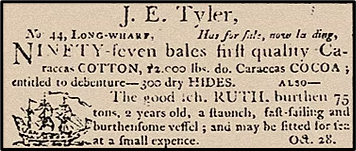
J. E. Tyler, No. 44 Long Wharf. Columbian Centinel, 28 October 1801. Copy at top right reads, “Has for sale, now landing,” meaning the ship was soon to dock and have the cargo unloaded, ready for purchase. While Tyler's trade card was designed as a business announcement and locator, newspaper ads had the advantage of immediacy, calling attention to fresh merchandise that could be purchased as soon as the advertisement caught the reader's eye.
Newspaper advertisements were a critical means to quickly broadcast what merchandise he was trying to flip. In 1801, his first full year of business, he ran sixteen ads (plus each ad usually ran for several issues); but his advertising frequency dropped in 1802 by more than half. In 1803 Tyler’s newspaper advertising dropped steeply again; he was running only a quarter of the ads he had placed in 1801. England and France were at war and although the U.S. tried to maintain its neutrality, both countries attacked American shipping, seizing the ships and their cargoes. To add to the uncertainty of the future, the Tylers gave birth to their first child in September 1803: Hannah Parkman Tyler. John’s business was struggling at the same time that his family was growing – he needed an ally.

WARTIME ALLIANCE (1804-1810) 

In January 1804, the records of Westborough’s Congregational church noted, “Mr. John Eugene Tyler & Hannah Breck his wife were dismissed from us & recommended to the church in Boston, commonly styled the Old South.” The Tylers were determined to live in Boston but they needed help to make it all work. By April of that year, No.44 was vacant again and in May, Breck Parkman had a nephew who was running his own commission merchant business out of the same location, while John E. Tyler showed up at No.41 Long Wharf in August, perhaps a more affordable location than his former business a few doors down the wharf. In October, John’s father-in-law intervened, either to help John fix his business, or out of concern for his daughter Hannah and his grandbaby Hannah, or perhaps genuinely to help all three. The co-partnership took second-floor rooms at 83 State Street, a few blocks away from  where Long Wharf attached to the city. The announcement stated that Breck Parkman, “the senior partner,” would continue to run his store in Westborough while Tyler and a third partner named Parker would work out of Boston, a few blocks from Long Wharf. In promotional literature for Chamberlin's Patent Bilious Cordial, the medicine’s newest agents weren’t listed as based in Boston but as “Parkman, Tyler & Parker, Westborough” – father-in-law Parkman was the company decision-maker and clearly in control, even from his home thirty miles away.

Both of the partnership’s two locations focused on “a great variety of English, India and West-India Goods, at inviting prices, by wholesale or retail.” The new partnership was broadening Tyler’s previous approach of selling large lots to substantial businesses; the new firm was now encouraging retail sales as well – selling “by the package or piece for cash or short approved credit” – especially to attract fashion-conscious female patronage.

The Napoleonic Wars continued to disrupt American shipping and trade. Engaged in a war for the control of Europe, Britain and France continued to impose trade restrictions, ship seizures and blockades. Despite the challenges, the new partnership of Parkman, Tyler & Parker was able to deliver on its promise to supply shiploads of foreign merchandise. Their seven newspaper ads over the span of two years, 1805-1806, announced a wide variety of goods from London and Liverpool including ladies’ purses, pearl buttons, and pocketbooks; opera glasses and Britannia tea pots, “bombazets, calamancos, ruffellets, and shalloons,” blue, brown, and “bottle-green broadcloths,” and a host of fashions for every season. In July 1806, during his busy efforts to make the partnership succeed, John Tyler became a father for the second time with another daughter.  

In March 1807 the partnership was dissolved and a new company was formed, substituting Parker with Breck’s oldest surviving son, Charles. The new firm was called Parkman, Tyler & Parkman: Breck was 58, John was 41, and Charles was the junior partner at 22, apparently being taught the merchant business by his father similar to how he had been mentoring his son-in-law John. Throughout the balance of the year, however, hard times for ship owners and merchants continued. In late December President Jefferson signed the Embargo Act into law, prohibiting American ships from undertaking voyages to foreign ports; the act proved devastating for the American economy, particularly for port cities like Boston, where ships lay idle at the docks.

ree
Tyler and his business partners brought two customers to court in each of the two years preceding the embargo for nonpayment of their accounts, but in 1808, the year after the Embargo act was passed, he brought eight to court for the same offense – nonpayment of goods sold and delivered according to the terms and time frame in which they promised to pay – and he won every case. One of his delinquent customers was Samuel Chamberlain, maker of the Patent Bilious Cordial. In another law suit, the sheriff was instructed to put the two defendants in jail until their debt to Tyler’s partnership was paid off. The years of selling goods on credit were playing havoc with his balance sheets each time business conditions softened and after the Embargo Act, when Boston’s economy took a severe downturn. In 1808 John E. Tyler seemed to spend more time as a plaintiff chasing delinquent customers than as a commission merchant courting new ones.

In 1809 the law suits continued but the partnership’s newspaper advertising did not; the era of partnerships for Tyler was coming to an end. He needed to find a better solution; his business was on the decline but his family continued to increase – his third daughter was born earlier that year.  Starting in late 1810, Tyler went into business on his own at the same 83 State Street location where the Parkman, Tyler & Parkman partnership formally ended at the beginning of 1811; oh, and his fourth daughter was then born in June. More than ever, he needed to get control of his business and his balance sheet. Then in June 1812, the U.S. declared war on Great Britain.

THE LAST HOORAH (1811-1815)

During the war years, 1812-1815, John E. Tyler managed to post five newspaper ads, all of which were for goods from North and South Carolina – bushels of corn, hogsheads of hams, gallons of turpentine, varnish, and pitch, casks of rice, boxes of soap, and kegs of tobacco. This reveals he was relying on coastal trade; given the British blockade of American ports during the war, the goods he was able to sell were probably the result of smuggling, privateering, and other illicit methods of maritime skullduggery to sneak past the British ships. After a peace treaty ended the war in February 1815 and the Battle of Waterloo ended the Napoleanic Wars in June, Tyler and the other merchants of Boston were once again free to resurrect their businesses; by November, he was offering Russian iron from a ship from St. Petersburg, Russia, and “a few boxes of best Havanna Cigars”; the oceans were finally open for business.

Almost as if a symbol of celebration, in October of 1815, John E. Tyler became a father for the sixth time – to a fifth daughter; the fifth child, a son, had been born in 1813, a little less than a year after the war had been declared. Perhaps fatherhood had weighed into his decision to become a deacon in his church and the treasurer of the American Society for Educating Pious Youth for the Gospel Ministry in December 1815. John and Hannah begat two more children (eight in all) before they were done: a daughter in 1817 and finally a second son, John Eugene Tyler, in 1819, when his father and namesake was 53 years old.

TAPS (1816-1821) 

Despite the war, the blockades, the delinquent customers, and other obstacles to his career, the last five years of John E. Tyler’s life may have been the hardest on him. He had to endure the grief of losing three of his children in 1816 (14 months old), 1818 (4 years 10 months), and 1819 (16 months). His business had become quiet in the newspapers, advertising goods for sale just six times between 1816-1821, the most notable being a few hogsheads of apothecaries’ vials for sale in 1816 and a quantity of New Orleans cotton and patent silk hats from southwestern England in 1819. Similarly, he shifted his business location in Boston four times in those last five years for unknown reasons, though I suspect it amounted to reducing expenses to a bare-bones budget.

Headstone of Dea. J. E. Tyler, Pine Grove Cemetery, Westborough, MA. Note that the engraving lists him by the title of Deacon, no Doctor. Also note the birthyear is incorrect and should read 1766. Find-A-Grave. Photo courtesy of C.Kay.
John E. Tyler died on the morning of 25 January 1821 at age 55; none of the three newspapers announcing his death explained the cause. It does not appear to have been anticipated since he died intestate, but then there wasn’t much left to protect; after the creditors’ claims were resolved, his estate was declared insolvent. His wife and children moved back to her father’s house in Westborough and even their pews in Boston’s Park Street Church  were sold off to help pay off the creditors. To punctuate his story with a final sadness, his 15-year-old daughter died in Westborough before the year was over.

Having contemplated his entire life, I feel that his trade card reflects the high point of his life – at least the business portion of it. Newly married, moved into Boston, and ready to do business with the world, he commissioned the card – probably the only artwork he ever commissioned – to reflect his optimism, ambition, and excitement as a new Boston merchant in the new United States. It was a bold, proud, and free expression of his dream. His subsequent life does not seem to have lived up to this apex frozen in time, but we see it now, 224 years later, and are humbled at the thought that this country we enjoy so much was built on the backs of people who weren’t afraid to dream.
 
Lynn Massachusetts History – History of Medicine – 19th-Century Health Remedies – Vintage Medical Ephemera – 19th-century Medicine
 
 
UPDATE: July 2025 - A very rare, unusual galvanic battery was listed this month on eBay, and I secured the kind permission of the seller to show the item on this blog post. Definitely worth a look - SEE THE STARTLING IMAGE NEAR THE BOTTOM OF THIS POST! It has a fascinating mixture of cosmic symbolism: the sun and a crescent moon, two hearts, and a pair of all-seeing eyes, all framed by a horseshoe and divided by a Christian cross. A potent combination of talismanic protection from illness, bad luck, and evil - talk about a defense and cure-all for anything evil that might approach!

It doesn’t happen often.

After 40 years of collecting Victorian advertising, it has to be something truly special to catch my eye. It must be so different that it makes me do a double-take. My finger slips off the mouse button, and my head leans forward, bringing my face close to the screen. My eyes go into microscopic-focus mode to ensure I’m not imagining things. My brain kicks into overdrive, checking my virtual collection to confirm I don’t already own one. It studies the subject for possible subliminal messages, cultural significance, and historical relevance. I soak in the richness of the colors, the allure of the graphics, and the brilliance of the design.

On those rare occasions when the image exceeds my wildest expectations, the little boy in me pronounces the official response of my experienced, high-level analysis:

“Cooooool!”

Click. Somewhere out there, I’ve made a seller happy. Okay, calm down, adrenaline; it’s mine.

The Discovery of Hall’s Galvano-Electric Plaster

I recently had such an experience, and I’d like to share it with you. About a month ago, I saw the Hall’s Galvano-Electric Plaster trade card for the first time ever. I’ve spent so much time examining this card and researching the backstory of the product and its advertising that it has taken me until now to be ready to report my findings. I discovered far more about the product and the man behind it than I had expected. This has left me in a quandary about how to present it in a blog post.

I’ve decided to approach it differently: this post will focus exclusively on this one advertising trade card, while the next post will delve into the whole story—the inventor of this product, his life, how he created this particular medical item, and what happened to both him and his invention.

So for today, let’s focus on the curious medical device that bamboozled both the patient and the inventor alike: Hall’s Galvano-Electric Plaster.
ree

Mustard and Frogs’ Legs

The inventor of this device was Reuben P. Hall, a former peddler with no formal medical education. However, what he lacked in knowledge, he made up for with a vivid imagination, meticulous ingenuity, and keen perception. He saw two medical treatments—ancient plasters and modern electricity—being used for the same aches, pains, and diseases. In 1874, he figured out a way to bring these two methods together into one new and improved solution.

For centuries, wives and mothers made a home remedy called plasters from ingredients they had on hand. Mustard plasters were the most common form, made by mixing mustard powder, flour, and water into a paste. This gloopy mess was spread on one side of a piece of fabric and applied wherever on the body it was needed, such as on the chest for colds and congestion or on the back for arthritis, muscle pain, and backache. The mixture provided penetrating warmth to the area beneath. Today’s more modern-sounding and medicinally improved “pain relief patches” are the evolved descendants of this time-honored practice.

In 1874, electricity was still more mystery than science when Reuben claimed he had harnessed it in his plaster. Almost a century earlier, the Italian physician Luigi Galvani applied an electrical spark to a dead frog, causing its legs to twitch with animation. This result led many to believe that if electricity could bring life to part of a dead frog, it could help revive and restore humans’ pained and diseased bodies. Consequently, all sorts of medical devices promising rejuvenation emerged, often referred to as magnetic or galvanic electricity. People bought hand-cranked magneto-electric units to cure ailing family members at home, sometimes combining low-voltage shocks with steam cabinets and baths. Others purchased belts lined with various configurations of metal discs or cylinders to be worn under their clothing, next to the skin, to generate an electric current through the body. Often, men’s belts included a scrotal sack feature hanging below to bring some zip-a-dee back to the doo-dah.

Patented Magic


In his patent application, Reuben Hall provided a detailed review of the ever-expanding array of electrical appliances being foisted on the public. He also pointed out their shortcomings, the worst of which was the lack of traditional medicine being passed into the body. Unlike the age-old mustard plasters, electricity was the only medicine served up by the new medical shock equipment:

Electric currents have long been used by the medical profession in the treatment of many diseases. They have been applied in many ways. Currents from batteries, induction apparatus, or frictional apparatus have been used, by means of wires and electrodes placed on designated parts of the body. In other cases, they have been applied through the medium of baths, and in still others, by Voltaic belts, to be worn upon the body, the current being there both generated and applied. Their use has not been as extensive as it might have been, for the reason that while they were used, the ordinary exterior local applications of medicine could not be used, as was often desirable.

In electric baths, this has been remedied to some extent by enclosing the bath and supplying medicated air or vapor to the patient while under treatment. This involves a cumbersome and expensive apparatus, and can be used only for limited periods and at intervals.

Reuben then presented the patent examiners with his alternative—a unique invention in the medical electricity marketplace: a medicinal plaster with electrical components embedded in the fabric. On his detailed illustration below, two “electrically dissimilar galvanic elements” (like copper and zinc), labeled “P” and “N,” were heart-shaped metal plates connected by a wire underneath. Human perspiration completed the electrical circuit started by the two hearts and wire, producing a current. The latent electrical energy in the human body was thus triggered into action, much like the frog legs.

ree

The key difference between Reuben’s invention and all the other electrical devices then in existence was the combination of electricity generation and simultaneous medicinal application. Yet ironically, his patent drawing downplayed what medicine should be used:

E is any suitable base or fabric, upon which is spread any suitable medical compound, A. To the composition of this compound, I make no claim as it may be varied to suit various conditions or diagnoses.

Customers or their pharmacists could apply whatever medication they chose to the plaster. It wasn’t so much that Reuben was ambivalent about the medicine; he was focused on developing the next generation of electrical medicine. That, apparently, was where the real money was.

ree

Miracle Born in the Storm Clouds

I’ve only seen this one advertising trade card for his product—I doubt there were any more. This trade card design captured the curative magic of Hall’s Galvano-Electric Plasters, showing the dramatic transformation from sickness to health. Under decorative arches, the archetypal before-and-after combination of a sick man and his healthy counterpart clearly displayed the benefit of the plasters. There could be nothing better than the visual of a man tossing his crutches and doing a jig to demonstrate the miracle of Hall’s plaster. Before-and-after visuals were a popular and often-used convention for medical advertising; Parker’s Ginger Tonic and Buckingham’s Dye for Whiskers were two such products with several equally effective variations on the theme. Tossing one’s crutches and doing a silly dance was a powerful way of showcasing the cure’s effectiveness and the joy it brought.

To keep the customer focused on the product even longer, a poem followed the illustration. Written in contrived quatrains of butchered iambic pentameter, the point was not to present a timeless sonnet but to amuse and vividly praise Hall’s plaster for capturing the power of the gods: lightning –

Deep in the storm cloud’s womb I have my birth,
Thence flashed by Angel’s wings from Heaven to Earth,
Under the magic of my touch, old Pain
Wages his fiercest warfare all in vain

What Heaven-borne power slays disease’s demons in an hour?
… the mighty master –
… Hall’s Galvano-electric plaster!

The card displayed first-rate creativity but second-rate execution. The artwork was nice but not refined, the color palette was minimal, and the poetry was hackneyed. However, the message was crystal clear: Hall’s Galvano-Electric Plaster cured the hopeless and miserable. An 1878 advertisement in the Boston Globe stated, “STOP PAIN AS IF BY MAGIC. THEY REALLY PERFORM MIRACLES.”

The trade card’s reverse side has a few variants. The version shown here is the trademark registered in January 1877 (see the evolution of the trademark design further below). The advertisement describes the “Galvanic Battery” embedded in the plaster that produces “a constant but mild current of Electricity, which is most exhilarating” when the electrical circuit is completed by being put in contact with the body. Twenty-five medical miseries, ranging from weak eyes and constipation to lung and heart disease, would be speedily cured by the electricity, “those subtle and mysterious elements of nature,” produced by Hall’s plaster. The last promotional line summarizes the benefits illustrated on the card front, once again promising nothing short of miracles: “They cause the Lame to leap with joy and the Halt to take up their beds and walk,” subliminally reminding the reader of the same miracle performed by none other than Jesus himself. (John 5:8-9; also see Isaiah 35:6)

ree

ree

Professor of Nothing

It wasn’t just lightning that was in the clouds; doom was in the air as well.

Hall’s plaster advertising ran across nine states in 1874, but the number of states kept diminishing each year thereafter. Just a few short years into the sales of Hall’s Galvano Electric Plaster, a lightning storm of new-fangled electrical medical devices made their appearance across the land—and on people’s upper chests.

These devices were also described as galvano-electrical batteries but lacked any medicinal plaster component. They were distinctly designed to be stylish, even fashionable jewelry-like medical devices: small and shiny, suspended most often by a silk band, worn at the top of the cleavage. Although the instructions generally recommended wearing them “as close to the heart as possible,” they were pretty items, with a pleasing arrangement of disks made from different metals like bronze, copper, nickel, and zinc, arranged in a circular pattern around a central object. This central object could be a flower, hexagon, cross, heart, or other design, each created by a different manufacturer. Most were enclosed in a circular band of bronze or white metal; one was edged in a horseshoe pattern, and Scott’s Galvanic Generator was extra-fancy, with a sculpted winged cherub holding bundles of lightning bolts on one side while the reverse side had a zinc fist similarly clutching lightning bolts, all embedded in a copper shield. Hall’s Galvanic-Electric Plaster was expected to be hidden under clothing; Boyd’s Battery, Scott's Galvanic Generator, and the rest of the batteries produced from 1878-1886 were designed to be the center of attention and in the public eye.

London Galvanic Generator, Pall Mall Electric Association, ca. 1881. (left) front side - winged cherub sculpted in Lionite, holding bunches of lightning bolts; (right) reverse side - copper plate with embedded zinc in the shape of a fist holding lightning bolts. Rapoza collection.
While their public exposure surely increased their popularity, it also brought them condemnation from critics who insisted they weren’t providing any medical benefit at all. Calling electric batteries “toys,” the faultfinders guffawed that “a wooden button worn upon the breast would be quite as effective as the so-called ‘batteries’ which have hitherto been sold as curative to an over-credulous public.” They even claimed that wearing a slice from an ear of corn would do as much good (and look pretty much like) as one of the batteries. To the critics, the popular belief in the curative power of electric batteries fell into the same realm of superstition as those “otherwise intelligent persons [who] believe that carrying a Horse Chestnut in the pocket will keep off rheumatism.”

The detractors also targeted the “before-and-after” illustrations that Hall’s plaster and other electric battery companies used to promise amazing results. The critic’s sarcasm was as vicious as it was humorous:

There is a picture of a man without any battery, labelled “Before Using,” and another picture of a man with a battery, labelled “After Using.” Now if these pictures are accurate representations of the man before and after, we protest against its use. One has only to wear one of these things, and his own mother would not know him. A rogue has hereafter no need to go to Canada to escape justice. All he has to do is to wear one of these batteries, and if these pictures are true, he becomes another man altogether.

Electrical batteries like Hall’s and all the rest faced stiff headwinds at the same time they were being warmly received by the public. They didn’t last long, likely due to a combination of significant critical opinion and the fact that they simply didn’t work.

There is no more development of electrical action between these bits of metal than there is between the coins in one’s pocket—and we pronounce the thing to be an UTTER BARE-FACED FRAUD.

People still suffered from weak eyes, constipation, and heart disease even though electrical batteries dangled from their necks or Hall’s Galvano-Electric Plaster stuck to their backs. If there was any improvement, it was more likely the result of time and nature providing their own remedy or, in the case of constipation, time and nature might be aided by a heaping plate of beans.

During an intense courtroom cross-examination in 1882, one of the leading electric battery manufacturers, Professor John C. Boyd, was asked, “Professor of what?” Responding under oath, his telling reply was, “Professor of nothing.” His credentials, like his product, were a ruse, good for nothing. The only thing shocking about Hall’s plaster and the subsequent wearable electrical batteries was that they didn’t work; they didn’t generate electricity, and they didn’t cure or remedy disease. They do make great patent medicine antiques, though!

Just like Iron Man's Arc Reactor, Hall's Galvano-Electric Plaster and all the small body batteries that followed should have stayed in the world of fiction; maybe they can be included in the next Iron Man movie!

(left) Lowder's Magneto-Electric Battery (center design: two circles within a hexagon), ~1886 (courtesy of the Wellcome Collection; public domain); (right) Richardson's Magneto-Galvanic Battery (center design: heart), Journal and Courier (Lafayette, IN, 25 MAR 1881).*
"Extremely Rare Galvanic Battery Medical Cure-All Medal, Token." Listed on eBay in July 2025. This is a very large and heavy battery; 2.75 inches x 2.28 inches (70x58 mm) and 1.59 ounces. The back is stamped "Made in Germany," but the eBay seller stated it was not; that was often stamped on items during the late 19th century as a sign of quality. (Courtesy of eBay seller thbco. This image is not linked to the eBay page because it has already been sold.)
ree

(left) J. R. Flanigan Medal Battery, 1880; (center) John M. Lewis, 1880; (right) Boyd's Battery, 1878. (from patent drawings and other public domain files)
Lynn Massachusetts history - History of medicine - 19th-Century Health Remedies - Vintage Medical Ephemera - 19th-century medicine
 
 
How much was too much for a new life?
"A New Thing Under The Sun": front bottle label for Price's Patent Texas Tonic, ca.1845. (Courtesy of PeachridgeGlass.com)

To the best of my knowledge, there is only one bottle from the era of the Republic of Texas (1836-1845) that actually has the name of that short-lived country embossed on it. PeachridgeGlass.com 
states that only three examples still exist, and I have recently had the privilege of holding one of those three treasures in my hands. I thought I could make a worthwhile contribution to history and the bottle-collecting hobby by researching and writing about Price’s Patent Texas Tonic. The results? A web of patent medicine connections between a war hero, governors and ministers, slaves and  plantations, Mormons at Nauvoo, Transylvania University, and the infertility of a U.S. president. I came to realize that probably only three examples of this old glass bottle still exist because the others burst at the seams with the explosive story they tried to hold inside.

Opportunity Knocks

The year 1840 was a hopeful, fearful, profitable, risky time to be in the Republic of Texas. The continent’s newest country had come into existence just four years earlier when the far superior, better equipped, professional army of General Antonio López de Santa Anna had been soundly defeated by a ragtag assemblage of untrained volunteers under Sam Houston. Suddenly, the northeast borderlands of Mexico had become the Republic of Texas, where land was cheap and plentiful, and opportunity was as big as the Texas sky.
Map of the Republic of Texas, ca.1837. The area under control is in pink; the area disputed by Mexico and Texas is outlined in a solid red line; the disputed area included what today comprise sections of Kansas, Oklahoma, New Mexico, Colorado, and Wyoming. McConnell's historical maps of the United states (Courtesy of the Library of Congress, Geography and Map Division).
Even with the challenges of continued Mexican raids, Comanche, Kiowa, and Apache attacks,  a lack of roads and mail service, and a seasonal rotation of epidemics, the opportunities proved irresistible to the many arriving from the U.S. and Europe. The defiant taunt that had been stitched into the Texian flag at the start of the revolution could have been willfully misread by the new wave of opportunistic invaders as a friendly invitation: "Come and Take It".

The Merchant Prince

No one heard the siren call of opportunity in Texas more than a certain middle-aged merchant of Nashville, Tennessee. His name was John Price and he was all about the money. It was how he measured his house, his business, and even his family. Born in 1790, some of his values were formed in his childhood: his mother was a devout Methodist and his father was a slaveowner. He was remembered as an eccentric man but shrewd, fond of Methodist camp meetings and a zealous participant in revivals. Deeply involved in Nashville’s Methodist church, he was a manager of its missionary society and bible society, as well as the county temperance society.

In 1814 at age 24, he married the daughter of a Methodist preacher whose family were said to also be quite wealthy. From the time of his first marriage and into the 1820s, John Price was already one of Nashville’s elite, a slave-owning merchant, selling virtually anything for a profit and renting out houses and warehouses for still more gain. His advertisements listed for sale or barter everything from 19,000 pounds of pig lead, 400 pounds of cotton, 40 hogsheads of tobacco, 100 barrels of pecans, and 500 bags of salt to Kentucky Whiskey, Virginia tobacco, Jamaican rum, and peach brandy. His ads were also found selling sugar, coffee, and bacon, a large work horse, anvils and vises, and cooking and parlor stoves. His strong support of Methodism was clearly a strong motivation behind him also selling a popular Methodist book, Adam Clarke’s Commentary on the Bible, and he got his first taste of promoting and selling medicines with Lorenzo Dow’s Family Medicine, the product offered by the eccentric, unorthodox, and zealous traveling Methodist preacher who was widely known as “Crazy Dow.” His first ad for Dow’s medicine in 1828 listed the he had an inventory of 3 dozen bottles along with the hogsheads of tobacco and the barrels of pecans; a year later he still had a few bottles of the stuff left and tried to get rid of them by bluntly pushing,

“LO OK– DOW! –Save yourselves from sickness and death.”

Not only had John Price made the effort to help out the Methodist preacher, but his wealth and reputation seemed to have helped him establish connections with some of Nashville’s favorite sons, like Sam Houston, who became governor of Tennessee and later the Republic of Texas, and James K. Polk, who became President of the United States. There’s no evidence that John Price sought elective office, but he may have risen from a merchant to a merchant prince had he stayed in Nashville long enough.
Five-Dollar Bill, Republic of Texas Currency, ca.1840. Five dollars was all the money John Solomon Fullmer had when he arrived in Nashville, not nearly enough to get permission to marry the daughter of John Price; it was, however, enough to buy a bottle of his Texas Tonic. (Courtesy of CABANISS CURRENCY).
Father Knows Best

The wealth and luxury he was busy accumulating provided more than just a birthright for his children to enjoy; it was a social status they were expected to maintain. They grew up with servants and houseslaves, a handsome home and fine clothes, and received the best education money could buy, but they were forbidden to marry beneath their station. John’s oldest daughter, Mary Ann Price, was a perfect example of her father’s formula for success. She was his oldest child and never had to experience need or hardship. She had her own maid and a private tutor and she graduated from the Female Academy of Nashville. But then she went and fell in love with the wrong guy.

Mary Ann had turned 21 in September 1836; in the eyes of the law that made her an adult who could choose the man she wanted to marry – but not in her father’s eyes. The man she loved was John Solomon Fullmer; he had some education, worked hard at a newspaper, and showed entrepreneurial promise but he had arrived in Nashville a few years earlier with “a five-dollar bill in his pocket … without friends … and no training in a trade” – not at all good enough to marry a daughter of John Price. His marriage proposal having been rejected by the obedient daughter, the embittered beau put all the blame on the “wicked and avaricious heart … of Old John Price”:

… Mary’s reject[ed] me, solely for her father's sake … I have abundant evidence that she loves me still, and that she would still marry me if she were not prevented by her father; but without his consent she would not marry any man living.

The young lovers went off and eloped in May 1837 and her father never forgave her. About two decades later, another daughter of John Price married the man who had been the fourth governor of Texas; it was exactly the kind of union John wanted for his children while the unprosperous newspaperman certainly was not – and Price’s relationship with his daughter and her unacceptable husband only went from bad to worse.

In February 1841, the son-in-law non grata wrote to John Price about how he had taken Mary Ann far away, “It was no doubt with great surprise that you first heard of our removing to Illinois." In 1839, Fullmer had gone to the Mormon colony at Nauvoo, Illinois, where he was baptized by their founder and prophet, Joseph Smith. He then returned to Nashville to gather Mary Ann, their child, and possessions to move and join the Nauvoo colony. John Price was incensed at the planned move and offered Mary Ann a restoration of her wealth and social position if she would desert her husband and stay behind with their family in Nashville. Mary Ann refused and was consequently shunned by her father – she never saw her parents, siblings, or Nashville again.

John Price just moved on; while his forsaken daughter and her family moved over 400 miles northwest to Nauvoo, John took the rest of his family twice as far to Galveston, Texas. To him, his daughter’s departure was based on delusions while his was based on opportunity: he was certain she would pay for her choices, while he would earn for his.
Port of Galveston, ca.1845. Public domain book illustration, Library of Congress.
Making Money in Galveston

In March 1837, even before Mary Ann eloped, John Price was already preparing to move his family to the new Republic of Texas. He had entered into a business arrangement that apparently necessitated a substantial investment on his part.

In consequence of a recent compact entered into with a company of respectable gentlemen as their agent in the Republic of Texas … it is probable that myself and family will or may be required to move to the Republic. (emphasis added)

His preparation involved mortgaging his properties in Nashville and Columbia, Tennessee, and Huntsville, Alabama, to fund the relocation and business investment. It was a big move, a big investment, and a big opportunity. Three years later, early in 1840, the Price family, with the palpable absence of daughter Mary Ann, relocated to Galveston Island in the Republic of Texas. With a population of about 3,000 in 1840, the city of Galveston wasn’t even half the size of Nashville and it was dwarfed by New Orleans, which exceeded 100,000 but the tin island city was the front door of Texas; everything the new republic needed would have to pass through it. It was a merchant’s paradise.

The signature of John Price on a Galveston property document dated 6 November 1840. The letter "i" in the surname appears to be creatively dotted three times in sequence but it also could have been the result of a dripping pen trip.
John invested heavily in his new country; he purchased properties in Galveston, Jefferson, Crockett, Fort Bend, Sabine, and Bastrop counties, and city lots in Houston, Galveston, and Fort Houston – 11,262 acres in all by 1844. The Price family lived in a mansion on the north end of Galveston Island on Twelfth Street, between Church and Winnie Street. It fronted to the east towards the gulf; it was “one of the largest and most conspicuous residences in Galveston.” The family and mansion continued to be served by domestic slaves, starting with three under 15 and four adults upon their arrival in 1840, but settling for the next several years on one adult male, one adult female, and two children under 10. Some other items on which John Price was taxed included a gold watch, a silver watch, a saddle horse, and a “pleasure carriage.” He also became one of the founding members of the Methodist Church formed in Galveston and he purchased $100 in stock certificates ($3,600 in 2024 USD) that were designed to help reduce the Republic’s massive post-war debt. Just like in Nashville, John Price firmly entrenched himself in Galveston’s community, the church, his business enterprises, and his social station.
ree

Price also continued his work as a commission merchant, regularly receiving cargo from the sidewheel steam packets that came across the gulf to Galveston from New Orleans, like shipments of ice for which he advertised he would “keep a constant supply on hand for the accommodation and comfort of the citizens of Houston.” Supplying ice to Houston was as sure-fire as peddling ice cream in Hell – it was a guaranteed money-maker for the shrewd merchant.

He further invested his time and energies in inventing and patenting; John Price was one of the earliest residents of the new republic to get his ideas patented. In 1839, while still of Nashville, he had been granted U.S. patents on a cotton press (for compacting cotton into bales) and eleven days later for a burner of pine knots, providing a source of illumination long before the time of electricity. Over the following two years, as a resident of the Republic of Texas, he was granted some of the first patents the new republic issued. Two were for the inventions that he had been previously given U.S. patents; the other three were for a chimney, a mill-dam, and something he called a “Texas Tonic” – indisputably the first medicine patented in Texas. A cotton bailer, a chimney, a torch, a dam, and a medicine – his five inventions couldn’t have been more different from each other if he tried. He was remembered by one of his contemporaries for having original ideas – the variety of his inventions seems to have amply proved the point.
ree

“A New Thing Under the Sun”

Of his five inventions, Price’s Patent Texas Tonic was the only one that would require retail consumer interest to succeed; the other four were mainly of consequence for business and industrial applications, so his most visible investment of time and money was in the Texas Tonic.

The first advertisement found thus far, in the Civilian and Galveston Gazette of December 1846, featured the sunburst shown here and the slogan, “A New Thing Under the Sun.” He sold it at his business on the Strand in Galveston, the major commercial thoroughfare of the city and the entire region. Price told his newspaper audience to look for “the agency flag” there; that instruction, along with the street address and the sunburst image over the same ad, strongly suggests that the flag marking his business on the Strand was the sun graphic appearing in the ad. The bold image on a flag would indeed make his place easy to locate.

According to his advertising, the tonic bitters, as the back label called them, was first and foremost a cathartic – a powerful laxative that would clear out all the evil, disease-ridden gunk that clogs up a sick person’s internal plumbing, causing maladies from indigestion, constipation, and migraines to hemorrhoids, dizziness, and rheumatism. It also helped prevent the onset of the chills and fever, an enormous seasonal problem in the South. Testimonials appearing in his ads spoke most often of the tonic’s remedial effect on indigestion, chronic headache, constipation, and ague and fever. His ads also stated it was safe for children and “Peerless for females, in a delicate state,” meaning pregnant. Another important medicinal promise, presented in rhyming verse, was that it would cure infertility,

Barrenness.

Oh cheer up your spirits! don’t look so shy,
If husband’s ashamed, a servant can buy;
In three weeks or so! perhaps not so soon,
Gaze with delight on the beautiful moon;
Your eyes become bright – a heart filled with joy,
Good prospects in view – a Girl or Boy.

Aqua medicine bottle with beveled corners; open pontil and short-style double-tapered lip, ca.1840-1845. [LEFT:] Embossing in the front sunken panel: Price's / Patent / Texas / Tonic; [RIGHT:] Embossing in the back sunken panel: Republic / OF / Texas. (Courtesy of PeachridgeGlass.com)
As boldly impressive as were the curative promises and the flag on the Strand, the caliber of the product’s endorsers was top-shelf, the elite of the social register with whom John Price liked to hobnob: an army major and a mayor, medical doctors and Methodist ministers, an ex-governor of Mississippi, the president of Kentucky’s Transylvania University, and even fellow Tennessean and hero of the Texas Revolution, President Sam Houston himself, who wrote with gratitude:

By occasional use of your Bitters within the last year (in all not amounting to one bottle) I am satisfied that my general health [within the last seven years] has not been as good as it is at present. … My opinion is so favorable of the medicine, that I will keep a supply on hand for family use. … [The testimonial is dated 1814, but that is likely a transposition of 1841, a common mistake during the era when newspaper type was set backwards and upside-down by hand.]

John Price was apparently of the opinion that the price of the medicine was proportionate to its importance – the more it cost, the more distinctively important it was. In a time when a bottle of medicine was usually priced at 25 cents ($9 in 2024 USD), John Price charged a whopping $5.00 ($180.18 in 2024 USD) per bottle, which he said held 100 doses.

Always interested in volume sales, he also offered a bulk discount to plantation owners of 12 bottles at half price to cover the needs of their family and enslaved workforce. Consequently, plantation owners were quick to offer their enthusiastic endorsements of Price’s Texas Tonic, “Prepare me a demijohn for my plantation,” wrote a New Orleans planter; “A negro woman of mine took a violent chill,” wrote another, "I gave her one spoonful; she was well the next day, and so remains” [emphasis added]. Another Texas Tonic ad claimed Senator John C. Calhoun “intends to keep it on his plantation!” and the Mississippi congressman (William M. Gwinn, M.D.) who shared that insight ended with his own endorsement, “I think it will become a valuable plantation medicine and could be introduced into the army and navy of the United States with advantage!” Music to John Price’s ears.

Even with the choicest of southern aristocracy lifting Price’s Patent Texas Tonic on a pedestal, the entrepreneurial spirit deep inside John Price whispered that there was still one more plum to be pulled – the President of the United States – the recently elected James K. Polk of … Nashville, Tennessee.

What a Deal I've Got for You!

It’s not clear whether John Price and James Polk had a friendship or previous business dealings over the years; the two men shared Nashville as their home and John was comfortable to write to the president-elect in a respectful but casual manner, with some familiarity and humor. He wrote two letters to Polk on 31 January 1845 while he was back in Nashville, probably on business: one letter was about Texas debt and the second pitched the Texas Tonic without mentioning it by name (a note within the letter suggests that First Lady Polk was already familiar with the product).
President James K. Polk and First Lady Sarah Childress Polk were married for 21 years when he became the president in 1845. Image ca.1848. (Courtesy of the James K. Polk Presidential Museum. Wikimedia Commons.)

Price believed the President-Elect and his First Lady had a deep sadness in their lives that he could help correct. The Polks had been married for 21 years at the point that John Price was writing to them and they were childless; it was an emptiness that John Price, the father of nine children, couldn’t imagine. As a child, James Polk was operated on for the removal of urinary stones, but it may have left him sterile or impotent. John Price didn’t know about that, of course, and so told the president-elect,

…if everything in regard to your Phisical [sic] history is orthodox or to use an expression more Classical “everything in Denmark is right’ you need not die without children! [emphasis added]

He was proposing that President-Elect Polk use Price’s Patent Texas Tonic to cure the “Elect Excellency’s” barrenness – it was an offer uniquely designed for the President of the United States: Price would give Polk with the tonic bitters for two years, free of charge; if the medicine proved useful, “My prediction!” Price proposed,

… that is if you should have a living child by your best half within 2 years & 9 months from the first of January 1845 you pay me $1,600 … for perhaps a boy worth $16,000. I say again if “everything in Denmark” is right. I’ve known a case at Natchez of very late occurrence that succeeded in less than 12 months & a worse one or as bad as yours! 

The medicine he sold to the public for the 2024 equivalent of $206 per bottle he had just offered to the president-elect for the equivalent of $66,000 in 2024 USD! Early in my career with a trading card company, our CEO developed a line of embossed, 24-karat gold-coated football cards that were extremely expensive, exponentially more than the standard pack of cards. His justification was that it was far more efficient and economical to sell a single Whopper for a million dollars than it was to sell a million Whoppers for one dollar each. The gold football cards were nonetheless a tough sell and our company went out of business shortly thereafter. James K. Polk was 50 years old when he received Price’s sales pitch and the First Lady was 42 years old. Whether or not the President tried the Texas Tonic, they remained childless for the rest of their lives.
Advertisement, The State Guard (Wetumpka, AL), 22 AUG 1848, p.4.

John Price was quite aware that he was making a daring pitch and a hard sell and immediately followed it up with the justification that many innocent people had to pay even higher fees to lawyers to keep from being convicted. He was reaching and he knew it. He ended his letter trying to be sincere and trustworthy:

I assure you solemnly & personally that I am in earnest & also that this is entirely & (unless you make it yourself otherwise, which I think you’re too smart to do) eternally with me private! … even Mrs. Polk I hope won’t read on this delicate subject the whole or any part of this Epistle! … One request – Don’t let Mrs. Polk see this!

In the midst of pitching his medicine to the public for $5 per bottle and to the President for $1,600, daughter Mary Ann pleaded for him to provide “a few hundred dollars” so she and her husband and family could join the Mormon exodus from Nauvoo “to avoid unheard of persecution and mob violence.” His son-in-law suggested, “We intend to leave for the West if possible, before or by the 1st of June; a bottle or two of your tonic … might be of service to us in an uncultivated prairie region[emphasis added]. Several months later J. S. Fullmer acknowledged receipt of two letters from his father-in-law, observing with concern, “you seem almost frantic with intense anxiety to rally us to a sense of our danger and Wonderful delusion.”

John and Mary Ann Fullmer escaped Nauvoo with their lives, their small children, and a few possessions in their handcart and eventually arrived at the Great Salt Lake Valley, where they did their part to establish a network of communities for members of their faith. As they went through their travels in the Far West, John Price was traveling through the Deep South, establishing a network of agencies for his medicine and promoting it in the newspapers. He set up agencies in Nashville, Tennessee; Selma and Wetumpka, Alabama; Frankfort, Kentucky; and Vicksburg, Mississippi; and his main agency for U.S. trade was at the business of his brother, Thomas Keene Price, in New Orleans, Louisiana; it was the hub of Texas Tonic sales and all the other agencies were spokes on the wheel. John’s own son, John Price Jr., was living and working the business with his uncle Thomas in New Orleans.

Preparing for the End of Days

In the closing days of 1846, John Price was in Galveston, preparing yet again for another extended trip to the east to promote his medicine and establish more agencies. At 56 years old, it almost seemed like he sensed his end of days might be near at hand, so two days before Christmas, he created his last will and testament, which he began, “Being on the eve of leaving Home for New Orleans & perhaps various other places in the U.S. & taking into view the various casualties of life…” and he left very specific, sternly-worded instructions for the continuation of the medicine business after his demise.

Mrs. Price has my Medical Recipe for Price’s Patent Texas Tonic, which she will wisely conceal, during a period of 2 years, after that my son William W. in conjunction with her will jointly hold the secret …

Never, - Never alter the Price of the Medicine 5$ per Bottle by retail and to families or planters at half price [for 12 bottles]

[be cautious in] writing or talk or needless exposure of the articles or mode of manufacturing this medicine … [the] loss of the secret … will be a sad folly. [emphasis added]

The persons who manufacture it should do it very privately.

The man who had been a thriving landlord in Nashville and a merchant in two cities, and who owned thousands of acres of land across the Deep South, was very, very serious about parlaying his one patent medicine into big business – it was not a pet project in between bigger endeavors – he wanted it to work.

It should be noted that all of John Price’s known business travel and newspaper advertising focused on points between Galveston on the west, Alabama to the east, and Kentucky in the north. Although it was called the Texas Tonic, its success was only minimally calculated for a Texas audience. During the years of the Republic of Texas there wasn’t a population or transportation infrastructure sufficient to justify the hope of mass marketing and sales inland. The tonic’s product name was more of a promotional device to attract the attention of other more established and populated areas of the Deep South; Texas was a brand-new country filling news stories, sort of like the curiosity that would be generated by an erupting volcano a few hundred miles away. The day was soon coming when the state of Texas was thickly populated, modernized and civilized to an extent that encouraged many patent medicine companies and thousands of other entrepreneurs, but in the 1840s the success of Price’s Patent Texas Tonic was always understood to be to the east of Galveston. It's highly unlikely that the bottle was manufactured in Texas but it was the home and base of operations of its owner.

On one of his many business trips for the Texas Tonic, John Price fell a victim to cholera in Vicksburg, Mississippi, one of eleven listed as dying of cholera in that issue of the Vicksburg newspaper. It was noted that he “died among strangers” but was respected by business associates, admired by church brethren, and loved by his family. Even his daughter Mary Ann begged for a daguerreotype or a locket miniature of her father to remember him by. And for all of his rough and gruff treatment of her, her husband, and their life choices, he was adamant in his will that “… all my children[are] to be equal in every respect and in all my Estate.” [emphasis added] Despite shunning his daughter, he loved her and you don’t need to take a tonic for that.

After his passing, the family focused on ending the medicine business moreso than developing it. In 1853 John’s widow and brother advertised that they wanted to settle the business's accounts and have all consigned product returned. In 1866 Thomas tried offering the tonic in new small-sized vials of 4 and 8 ounces and put government stamps on every bottle before they left his New Orleans office. In 1873 the recipe was being advertised for sale (most likely making John roll over in his grave), along with a “considerable” amount of remaining inventory. Finally, another 14 years later, in 1887, a fire in the building holding what was still being described as “quite a quantity of Price’s Texas Tonic, owned by the Price estate,” was totally destroyed in a fire of unknown origin. The inventory was insured, which makes one wonder if it was an arson to get the insurance compensation for a medicine that had no apparent value after almost 40 years of not getting sold.

So today there are only three bottles of Price’s Patent Texas Tonic known to exist, which makes them worth exponentially more than John Price was trying to sell them for to President Polk. Maybe he understood its real value after all.

ree

Lynn Massachusetts History - History of Medicine - 19th-Century Health Remedies - Vintage Medical Ephemera - 19th-century Medicine
 
 
bottom of page