top of page

Updated: Jan 20

His kingdom was very small (he was the only one living in it) but the story of its king is unforgettable.


      The era of patent medicines is littered with the advertising and bottles of those who were hugely successful, like Ayers, Warner, Kilmer, and Pinkham. But there were also thousands of “little guys” – one man or woman with little more than a big dream and the two-person teams whose medicine businesses lasted only a few months or sometimes just a week or two. Alfred Liscomb was one of the little guys, but don’t tell him that. He was a force of nature, determined to prove that he was, indeed, the King of Life.

      When I purchased the only trade card I’ve ever seen for this quack doctor, I knew nothing about him and was concerned that his location in Havana, Cuba, would make researching him much more difficult. Thirty-nine pages of research notes later, I have gotten to know him very well and, even though he spent little of his life pretending to be a physician, so much about his life, family, and career were fascinating, I just have to share his complete story here. I can’t get over how he experienced so much of the country’s history during his lifetime, from the California Gold Rush to the Civil War and Spanish American War, the emerging sport of baseball, big city crime, Tammany Hall, and Boss Tweed, quackery, a mental melt-down, and a lifelong passion to stay young. Yeah, it’s a long story but enjoy it; he did.

Halcyon Harlem, New York

      It was the time when Harlem was a pastoral paradise dotted with elegant country homes of the wealthy who commuted to New York City. Samuel L. Liscomb and his wife, Eliza Keeley, raised their family there: two sons, a daughter, and then Alfred Augustus who was the youngest, born 19 March 1834.

      Eliza had brought some money to the marriage; they weren’t rich but it was probably the reason they could afford life in the suburbs. Samuel was elected to be a firefighter in 1842 and then appointed a police sergeant in 1845, two positions controlled by the city’s patronage system that soon became identified with Boss Tweed and Tammany Hall. With his livelihood balancing on the thin branches of political whim, he decided to join an expedition to California during the Gold Rush of 1849, hoping to secure a rich future for his family.

Clipper Ship Card, ca.1850-1860 for the Clipper Ship California, promoting the ocean route from New York to the California gold fields. The four major routes to California during the gold rush - by ocean around Cape Horn; by ocean and across Panama; across the Midwest and the Rocky Mountains; and the Rio Grande route taken by the Liscombs - were each fraught with potential dangers and death from ocean storms, yellow fever, malaria, cholera, dangerous natives and desperadoes, and more. Courtesy of Wikimedia Commons.
He brought his oldest son, William H., 21 years old, with him; they were in the expedition of John W. Audubon (the son of the famous naturalist, John J. Audubon). They traveled by stage to Pittsburgh, by river boat to Cairo, Illinois, and down the Mississippi to New Orleans, took a boat to the mouth of the Rio Grande, then traveled 120 miles upriver to the Mexican shore across from Rio Grande City. There in the stifling north Mexico heat, the expedition was attacked by cholera. Audubon asked the group for volunteers to stay behind with the severely ill; William stayed with his father. Audubon wrote in his journal,

I went to the sick tents; poor young Liscomb, worn out and heartbroken, sat leaning against the tent where his father lay dying, looking as pallid and exhausted as the sick man, and almost asleep; I roused him and sent him to my tent to get some rest.

And on the night of 17 March 1849, after his father died,

The heavy trade-wind from the southeast sighed through the open windows of the long, twenty-bedded room we were in, [where] the deep moans of young Liscomb, who, dreaming, saw nothing but the horrors of his father’s death …

After burying his father, William stayed on with the expedition, becoming ill himself with dysentery to the point that Audubon feared they would also lose him; but he reached San Francisco and was one of 38 (out of 96 men in the expedition) who made it to the gold mines. In 1860, eleven years after the fateful expedition, William was still in California, working as a carpenter; he apparently found little or no gold.

      Although the heartbreaking news about the loss of Father Samuel to cholera must have hit the Liscomb home like a ton of fool’s gold, the family rallied and moved on; Eliza eventually owned property and a dry goods business; her estate value went from $10,000 in 1860 to $20,000 in 1870. (Putting this in context, the 1860 amount was the equivalent of $390,000 in 2025 USD and the 1870 amount would now be $490,000.)

Baseball Trade Card. While this card was printed in 1888, it shows a baseball game being performed without gloves, meaning it represented the 1850s and 1860s when Alfred Liscomb was playing. Rapoza collection.
      Alfred in particular seemed to lead an enjoyable, relaxed life as a young man. He became a store clerk (probably at his mother’s dry goods store) at 21 yrs old. He entered his pointer dog in a dog show and it won third place in its category. He also demonstrated a passion for the new sport of baseball, playing for the Harlem Club at several positions and was one of the team’s best hitters. A newspaper reported the game on  30 August 1859 was especially exciting, “The applause and cheering as good plays were made on each side were almost deafening.” Alfred Liscomb was recognized as one “of the players … most deserving of credit for their good playing”; he got three hits and made two runs in the 13 to 15 loss against the Eckford team of Brooklyn. In a 13 June 1860 match against the Continentals, in front of a thousand spectators, Alfred caught four flyballs as the team’s centerfielder and made four runs at bat; this time the Harlem Club won 35 to 13. When his team wasn’t playing, he frequently volunteered his services to be an umpire; some of those games ended with such final scores as 51-27.

      In 1856 he had followed in his father’s footsteps, becoming a volunteer firefighter at the Pocahontas Engine Company, No.49, in Harlem. This essential community service exempted this young men from military service during the early years of the Civil War. When the federal government imposed a draft in 1863 the exemptions no longer applied, but Alfred A. Liscomb was discharged before serving due to “disability”; it’s hard to imagine what physical or mental disability the active baseball player and umpire could have had that would exempt him from military duty. Although found unfit to be a soldier, he remained a volunteer firefighter for many years to come. In February 1864, five months after his release from military duty, Alfred, now 30, was married to Widow Sarah M. Churchill, 25, of Woodbridge, New Jersey; and raised her 5-year-old son as her own. Alfred and Sarah then had their one child, Blanche, in 1867.

Midtown, Manhattan – Life in the Big City

      During the remainder of the decade after the war, Alfred was the proprietor of a livery stable on 7th Avenue in the Greenwich section of New York City. In the next several years he flittered between being a merchant, a collector, and an inventor, holding a U.S. patent for an improved ash-sifter in 1874. Where would Liscomb land next? For the next four years, from 1875-1878, he listed himself as a physician, promising to cure fever and ague (think chills) in 24 hours “or MONEY RETURNED”. Customers could visit or write to either of his New York or New Jersey depots to get a package (bottle or box was not specified) of his cure for 50 cents. His advertising puff promised,

Next to an earthquake, which shakes up the bowels of old mother earth at a terrific rate, there is nothing which can compete with a fever-and-ague at rattling one’s flesh off the bones. This, in connection with malarial fever, will inevitably kill a human being, unless the aforesaid being calls or addresses Dr. Alfred A. Liscomb, of 200 East Twelfth street, New York, and 294 Fourth street, Jersey City, and obtains from him an immediate cure, which will be effected in twenty-four hours, or the money, fifty cents, will be returned. Better not delay.

      As suddenly as the dubious doctor had appeared, he disappeared and re-emerged, self-shorn of medical title, and becoming the superintendent of some apartment houses in Midtown Manhattan from 1879 to 1889. It was in this position that the disabled draft candidate found himself on a rugged battlefield vanquishing foes. Upon entering his fifth-floor apartment of the Adelphi flats he superintended, he was startled by a young woman rushing out of his home with a bundle in her arms – the teenager had burglarized his apartment and dashed past him, ran down the hall, and jumped into the dumbwaiter shaft, sliding down its rope “at a fearful rate” to the ground floor below. He pursued her by running down the five flights of stairs, “expecting to see the girl dashed to pieces at the bottom,” but instead, she was running toward the street door. He chased her and nabbed his criminal a few blocks away. “The flesh had been torn from the palms of her hands and from her fingers and her clothing was spattered with blood.” Police found there were 14 indictments against her for previous burglaries; she had served a 2-month jail sentence, “but obviously not reformed,” she was now sentence to four years in the penitentiary.

"The Death-Grapple." Two burglars attempt to hurl Alfred A. Liscomb off the roof of an apartment house; a female tenant pulls the coattails of one of the burglars to help out Liscomb. From The National Police Gazette, 15 March 1879, p.12. Courtesy of Internet Archive.
      Just a few weeks later, while sitting by the window of his fifth-story apartment, Superintendent Liscomb saw two young men acting suspiciously, “creeping along the roofs of the houses” across the street  and hiding behind chimneys; then they broke open a hatchway through which they passed down to the inside of the building. Liscomb ran over and up into the building and caught the burglars in the act of opening a trunk containing silver. Liscomb was in hot pursuit as they hightailed it up their ladder to the roof. “An exciting chase over the roofs to Seventh Avenue followed.” Fists and feet were flying as Liscomb finally caught up to them and the three men fought on the rooftop. The New York Herald luridly called it a “Death-Grapple” between the 45-year-old and the two burglars. The National Police Gazette sensationally described how the two criminals “proved too much for him and dragged him to the end of the roof” where it suddenly dropped off into an alley way down below. Liscomb “struggled frantically on the edge” as they tried to hurl him over. A female tenant appeared and successfully pulled on the coattails of one of the assailants and dragged him off of Liscomb. “This gave Liscomb a moment’s respite, and he improved it by striking the unknown man a heavy blow in the face.” That man ran off but Liscomb secured the young man with the coattails and brought him, still flailing away for several blocks, to the police; the collared burglar was an 18-year-old wagon driver. His partner in crime was eventually caught as well and the two perps, members of the Tenth Avenue Gang (one an ex-con), were each sentenced to state prison for eight years.

During his superintendency years, the Liscomb family developed a special friendship with at least one of their tenants, a young woman abused and abandoned by her husband. The tragic young victim committed suicide in February 1888, but had first sent a letter to Alfred Liscomb which read in part,

Dear Mr. Liscomb … I am so tired, weary, and broken-hearted. Keep the news [of my suicide] from blind mamma and kiss her for me … Many times you and your wife have saved me from death. You took me in and cared for me when those who should have done so turned me on the streets. God bless you for it. Perhaps if I could see poor mamma’s dear blind face to-night I might be tempted to live on and endure my misery. Ah, no; it is better so. Good night. ...

Alfred told the press, “A sweet, noble woman is dead” and Sarah wept bitterly. She was the “Blind Mamma” mentioned in the suicide note. For at least the first two decades of their marriage, she had been very artistic, painting pictures on black velvet and making dress patterns and intricate collages with colored bits of paper; but when Sarah began to have health problems, a disease in her eyes had caused blindness.

In contrast, Alfred, while described as “well-advanced in years,” was age-defiantly energetic and always ready to prove it. In the September following their young friend’s suicide, a reunion of New York’s old volunteer fire department was held in Harlem. About 5,000 people attended to honor the “Spry Old Fire Laddies … scores of men on the shady side of 50, conspicuous in red shirts and big stiff hats … they had a roaring good time of it.” A half-mile race for fire department veterans over 55 was entered by seven men, including Alfred Liscomb. The New York Herald described him as “a man whose long, wavy side whiskers made him look as if he might be either a well-preserved parson or a prosperous broker.” For most of the race, Liscomb and the eventual winner were the two leaders, “cheered on frantically by the big crowd.” The winner’s time was 2 minutes, 19 seconds and Liscomb gained the silver medal for coming in second. He was indeed on the “shady side” but not the way it had been meant; intentionally or not, he had cheated – he was six months short of his 55th birthday.

Betting on a Quinquagenarian Sure Thing

Alfred Liscomb had always prided himself on his physicality; from star baseball player to fighting assailants at the edge of a dangerous roof to running in a race, he had always exhibited great confidence in his physical prowess. Nothing was going to stop Alfred Liscomb. A staunch Democrat, he made wagers in 1889 on his party’s candidates for New York City mayor, the state’s governor, and on the reelection of 51-year-old Grover Cleveland as the country’s president, but Cleveland narrowly lost. By the terms of the wager with a Philadelphia banker, Liscomb was now obliged to walk from New York to Washington, a distance of 240 miles, in seven days (an average of 35 miles per day), or transfer $1,000 (almost $35,000 in 2025 USD) to the account of his wager opponent. Although he could afford to pay, such an idea never crossed his mind; he was determined to make the walk.

The wager and the result spread at the speed of lightning through newspapers across the country, all fascinated by the political angle and the brash and foolish high stakes gamble to which Alfred had agreed. A newspaper in Cleveland, Ohio, titled their coverage, “LOONY LISCOMB,” but the Philadelphian banker hadn’t bet against some out-of-shape nag but rather a born-to-race stallion. The Nashville Banner reported,

Mr. Liscomb is a thin, wiry old gentleman, fifty-six years old, and weighs 145 pounds. … Little daily jaunts of twenty-five miles or so have hardened his muscles and put him in splendid condition for his task. … He was confident that he would succeed in covering the limited time, no matter what the weather is.

The Philadelphia banker wasn’t nearly as hardy; he offered to pay Liscomb $500 to not make the trip because he didn’t want to shiver in the carriage following Liscomb to ensure he walked the entire distance. Liscomb told the New York Sun, “I accepted his offer, at the earnest solicitations of my wife and family. I am sorry now that I did it.” In his heart, Liscomb really wanted to “hoof it to Washington.”

From 1890-1895, Alfred Liscomb busied himself in real estate, investments, and even a furniture business. Dr. John Swentzel, Blanche Liscomb’s dentist husband, explained that his father-in-law Alfred “Liscomb inherited money from his mother [who died in 1880] … and besides that, was always in a position where he enjoyed a lucrative income.” Life may have had its advantages in large part because of his involvement in Tammany Hall, New York City’s powerful Democratic political machine. Swentzel stated that his father-in-law “was a well-known member of Tammany Hall, and his two brothers were for years in public office,” because of their Tammany association. (Brother Joseph was the penitentiary warden in 1874 who was accused of letting the incarcerated Boss Tweed live a life of luxury instead of prison hardship like the other inmates.) A thousand-dollar wage was a risk but nowhere near as dangerous as his “death-grapple” with assailants at the edge of a tall building.

Alfred Liscomb did, indeed, survive his wild wager and his death-defying rooftop fight, but an accidental fall on a Manhattan sidewalk changed the trajectory of his life.

Slipping Away

      Sometime in the winter, spring, or summer of 1896, the now 62-year-old Alfred A. Liscomb fell on the sidewalk at 51st St. and 6th Ave. in Midtown Manhattan (where Radio City Music Hall would show up over three decades later). There’s no record of what made him fall on that city sidewalk – uncleared snow and ice, cracked concrete, or perhaps a slippery manhole cover or coal scuttle. On January 10th, for example, the New York Tribune reported, “Broadway was the scene of many a tumble yesterday, and the slippery sidewalks and still more slippery coalhole covers were the cause of much trouble and pain to the unwary.” Liscomb blamed the city’s negligence for his personal injuries and they must have been substantial. He had filed suit for $10,000 – it was the 1896 equivalent of suing for $382,204 today. Serious injuries definitely happened on America’s sidewalks – Mary Baker Eddy’s fall on an icy sidewalk in Lynn, Massachusetts, was so severe that it effectively changed her religion. At such a high figure, Alfred Liscomb was essentially claiming to have sustained life-changing injuries and while both sides agreed to discontinue the lawsuit action in October, his life did, indeed, seem to have changed after the fall.

      In September Alfred was off his game; clearly not himself. The self-assured, driven, energetic Alfred A. Liscomb with a chip of hubris on his shoulder had been transformed into a pathetic, confused soul who, for the first time in years, seemed old beyond his years – and nobody was sure why.

"Liscomb as He was Discovered by the Police." Note the chain bound by a padlock, wrapped around his left leg and the post and also the top hat still on his head, quite unlikely after the alleged 72 hours of abduction and sedation. Artist's interpretation, New York Journal. 17 September 1896, p.5.
He had been found in a dirty cellar underneath a horse stable chained to a post. Two men who had gone into the dismal basement heard a faint voice from deep in the dark depths that pleaded, “Come here.” It was strange enough to find a human enslaved by a padlocked chain in a forgotten discarded chamber under the busy city, but everything about the man before them seemed like an absurd tall tale. They hadn’t discovered a long-forgotten, imprisoned derelict with tattered, filthy clothes and scraggly, overgrown hair. This was Alfred A. Liscomb, finely dressed in a perfectly clean, unwrinkled black suit and tie, his silk top hat still on his head, and a solitaire diamond stud glittering from on his spotless white shirt front. “There was hardly a speck of dust on his shoes, which bore evidence of a recent shine.” One of his discoverers later told the police, “There he sat,
as cool as though he were eating a turkey dinner.”

      It just made no sense.
Utter Confusion & Muddled Memory. Another artist's rendering of Liscomb with vivid side whiskers and more importantly a facial expression and hand gesture that were displays of significant confusion and uncertainty. The graphic of the chain and padlock in the background were symbolic of the whole bizarre story.  New York Journal, 17 September 1896, p.5.
Utter Confusion & Muddled Memory. Another artist's rendering of Liscomb with vivid side whiskers and more importantly a facial expression and hand gesture that were displays of significant confusion and uncertainty. The graphic of the chain and padlock in the background were symbolic of the whole bizarre story. New York Journal, 17 September 1896, p.5.


      As the police captain questioned him, the rescued Liscomb’s memory was foggy, faltered, and muddled, lacking any degree of conviction or clarity. His answers were “exceedingly indefinite” and he couldn’t account for discrepancies and gaps in his story. He struggled to explain details, seemingly because he didn’t know them rather than being unwilling to share them. His piecemeal responses contained more confusion and unresponsiveness than answers. Liscomb also said very little about his adventure even to any of his family. The police tried to fill in the gaps with their own investigation.

      Liscomb told them “a rambling story” that he had been in the cellar for three days and nights, carried there by two men who threw a horse blanket over his head (he had also said it was seven men). They then robbed him of $300 (he also said $360) and chloroformed him repeatedly over the three days and placed a gun on a beam over his head lest he should try to get away. Alfred couldn’t explain why he never shouted for help or shot the gun to attract attention. The doctor who examined him said he showed no signs of three days of starvation or of being repeatedly chloroformed. The police found a key in Alfred’s pants that unlocked the padlock on his leg chain. The thieves hadn’t robbed him of other cash he had in his clothes, or the solitaire diamond gleaming from his shirt, or his gold watch. And the watch, which was “made to run 30 hours, was ticking merrily,” even though he had been allegedly chloroformed for 72 hours. The police were even suspicious of the fact that “Liscomb’s assailants had selected a post to tie him to that gave him an opportunity to sit comfortably on a stone.” Even his hat was still on his head after a horse blanket had been thrown over him. All of this was above and beyond the fact that he was found looking like a gentleman ready to attend the opera rather than a victim of robbery and abduction.

      The press and the attorney for the stable owner publicly judged and convicted Alfred Liscomb in the court of public opinion. The newspapers proclaimed “Crime, farce or fraud?” “wild, weird story,” “queer yarn,” and “the man was faking,” and the attorney pontificated:

Get Liscomb here to court and I will prove to Your honor that he outrivals Baron Munchausen in the largeness of his lies and imagination. If a man such as he can concoct such fabulous yarns I think he should be put on the Island [where the prison was] to allow him to meditate over them. …

      Alfred was taken from the police station to his daughter’s home in New Jersey where he was confined to bed for several days with two doctors in attendance. He was diagnosed to be suffering from nervous prostration, a condition that could involve extreme mental and physical exhaustion, fatigue, headaches, insomnia, anxiety, irritability, and heart palpitations, all attributed to stress; today it would be called a nervous breakdown. He avoided visitors and barely spoke, even to family members. They and his closest friends were understandably concerned about Alfred’s strange story and confused behavior and they candidly shared their beliefs that he was not himself: “There is no doubt among the friends of Alfred A. Liscomb … that he is suffering from temporary aberration of mind.” Dr. Swentzel, his son-in-law, said the whole episode was “the dream of a wandering mind temporarily unbalanced.” The title of the newspaper article that conveyed these opinions of Liscomb’s inner circle was brutally blunt: “LISCOMB THOUGHT TO BE INSANE.” 

Before the strange September incident, Alfred had left his brokerage and furniture business activities and started to work as a wagon driver, delivering crates of Mrs. Winslow’s Soothing Syrup throughout the city; it was a distinctly blue-collar employment for a man who had been enjoying a white-collar lifestyle, another hint that life had suddenly taken a different turn for him. Within seven months of retreating from the stresses of the chained-in-a-cellar episode, the 63-year-old New Yorker walked away from his wagon business in order to  lead secret boatloads of men and ammunition to Cuba to help rebels fight for freedom against Spain. You can’t make this stuff up.   

Sneaking By

      On 15 April 1897 the aging Liscomb was making national headlines once again; both The Cleveland Press and the St. Louis Post-Dispatch were so impressed by his daring, illegal, and successful exploits that they even included the New Yorker’s portrait in their papers and the Dispatch did so under the column heading, “IN THE PUBLIC EYE.” During the Cuban War of Independence, over 70 illegal expeditions were undertaken from U.S. ports to smuggle much-needed weapons, ammunition, and supplies to Cuban rebels from U.S. ports but fewer than 30 were successful; most were intercepted by U.S. Navy patrols, and some by the Spanish Navy; two were wrecked and another was driven back to port by a storm. The expeditions were executed by Cuban exiles and American supporters – Alfred Liscomb was one of those.

Three Portraits of Alfred A. Liscomb. (left to right): Artists' renderings  in The Cleveland Press, 15 April 1897, p.4., and the St. Louis Post-Dispatch, 17 April 1897, p.4.; photograph on his trade card of 1910. Note, however, that the artist rendering of him in 1896 (see above) showed the longer whiskers closer to those of 1910; perhaps he had tried to clean up his image for the publicity covering his Cuba expeditions in 1897 then let them grow out again afterwards.
Three Portraits of Alfred A. Liscomb. (left to right): Artists' renderings in The Cleveland Press, 15 April 1897, p.4., and the St. Louis Post-Dispatch, 17 April 1897, p.4.; photograph on his trade card of 1910. Note, however, that the artist rendering of him in 1896 (see above) showed the longer whiskers closer to those of 1910; perhaps he had tried to clean up his image for the publicity covering his Cuba expeditions in 1897 then let them grow out again afterwards.
In May 1896, a Grand Cuban-American Fair” was held in New York City’s Madison Square Garden. The motto used by the event organizers was, “Cuba appreciates sympathy – She must have assistance” and Alfred Liscomb embraced the sentiment. He had friends among members of the Cuban resistance in New York and he owned property in Matanzas, Cuba, which had greatly depreciated in value since the insurrection began. At a large dinner event, New Yorkers had made the Cuban resistance their guests and the menu was composed of Cuban dishes. Alfred told one of the Cubans present that he would like to take an expedition to Cuba. The Cuban placed his own small steam-powered yacht moored at Perth Amboy, New Jersey, at Liscomb’s service. A member of the Harlem Yacht Club, Liscomb was a skilled navigator and yachtsman, so he decided to command the vessel himself. The press consequently referred to him as Captain Liscomb.

      Arrangements were speedily made, and on April 9th the little steamer Dream, commanded by Captain Liscomb and laden with munitions and 35 Cubans, left the harbor. The Dream was chased by U.S. Navy ships off the Florida coast, so Liscomb put the yacht in at Jacksonville, to allay suspicions that it was bound for Cuba. When it resumed its voyage it was followed by more patrol boats to two other Florida ports. Eventually the coast was clear, and Liscomb successfully navigated a course to Matanzas, Cuba where an insurgent band received it. His mission accomplished, he sailed back to Punta Gorda on the west coast of Florida where he found 40 young Americans and Cuban-Americans anxious to go to Cuba, so another expedition was soon under way and successfully landed at Cabo San Antonio, the westernmost point of Cuba, after eluding the vigilance of a Spanish gunboat. Despite improbable odds, the Dream and its intrepid captain had twice accomplished their missions and headed back home to New York.
Sarah Maria Churchill Dunn Liscomb, about 1878-1882. She is wearing what appears to be a silk taffeta dress which was standard fashion but also quite flammable. She became blind sometime after this picture was taken and in 1898 her dress caught fire because of its proximity to a hot iron stove - it was a common accident and always a tragedy. Courtesy of ancestry.com

      Teddy Roosevelt and his Rough Riders would free Cuba from Spain’s grasp in the next year; while they were the ones who would defeat the Spanish bear,  Alfred Liscomb had first given it a few good pokes. Although 24 years older than the future president, Captain Liscomb’s daring heroism and rugged individualism was cut from the same cloth as Roosevelt and his troops.

      Back in Harlem, Alfred read the grim news about the explosion of the Battleship Maine in Havana Harbor. But news of an approaching war didn’t seem to matter two weeks later, on 28 February 1898 when Sarah Liscomb, Alfred’s wife of 34 years, died in a tragic fire. The totally blind woman was sitting too near the dining room stove, warming herself with her 6-year-old granddaughter, when Sarah’s dress caught fire. The little girl screamed for her mother and grandfather and Alfred came quickly, rolling Sarah in a blanket to put out the fire, but she had been “frightfully burned,” and died several minutes later; Alfred’s “hands and arms were severely burned in his efforts to rescue his wife.”

 In 1900, even at 66 years old, something stirred in Alfred’s soul; perhaps it was the wanderlust engendered by sailing the high seas or the Caribbean climate, waters, foliage, and Cuban culture that were calling to him. The loss of his lifelong wife and the horrific, upsetting memories of their last moments together may also have made him want to search for the peace that only time and distance can provide. He decided to return to Cuba.

Cuba’s Fountain of Youth

Alfred came prepared to succeed and make money; he announced himself to his new Cuban neighbors as a physician once again (after a hiatus of over two decades) and he also tried to impress the locals by puffing himself up as a “BACTERIOLOGIST FROM NEW YORK CITY,” and an inventor of a new medical treatment. But the culture that responded would prove to not be impressed or gullible because he was fresh off the boat from the United States. Spanish newspapers warned:

… there is none as dangerous as the “quack” or the “yankee,” who possesses the art of persuasion like no other. … these asses in wise men’s clothing, unmasked, begin to emigrate [to places like Cuba] in flocks like tuna.

Back side of the trade card of Alfred A. Liscomb, 1910. On the front side he identifies himself as "Dr." and on the back as "Prof." as well as a bacteriologist and inventor of a medical treatment. But the fact that he was "FROM NEW YORK CITY" seemed to be the most important credential he was trying to convey; however, it didn't seem to have brought him any additional respect or attention. Rapoza Collection.
      To say that Alfred A. Liscomb had a hard time settling in at Havana, Cuba, would be an understatement. In 1900, his first year of residency, He was arrested four times: first for fraud (perhaps in his medical practice), then twice for public indecency, for which on the second occasion he was sentenced to ten days of community service, paid a fine of ten pesos [$10 USD] and posted “a bond of 500 pesos to guarantee he would not disturb the peace of the neighborhood.” His last court appearance was “for mistreating one’s neighbor,” the court report noted cautiously, “Alfredo A. Liscomb, another doctor, but American, acquitted.”

In March 1904, the quickly aging doctor decided to pull one of his most successful self-promotions out of his bag of tricks: betting on his walking and running. Even The Boston Traveler picked up the human-interest story of

Dr. Alfred Liscomb of Havana celebrated his 74th birthday [it sounded even more amazing, but he was only 70] a few days ago, and on the night of the anniversary he employed some of his surplus energy in winning a bet which he had made that he could walk and run a mile [2 miles total] in 20 minutes. The doctor covered the distance agreed upon in 12 minutes.  

      Exactly a year later, on his 71st birthday in March 1905, he was at it again, trying to impress friends and to promote his new cure, Agua de Oro:

Dr. Alfred A. Liscomb, who is famous for his athletic stunts in the city, has made a bet of another supper to some friends that on Sunday night, which is the occasion of his seventy-first birthday, that he will walk one mile and run one mile, or two miles in all, in the space of twelve minutes.  He is to start from the corner of Prado and Neptuno streets at 10 o’clock sharp, and the race will be as free as the air to all. This event is to prove the efficacy of the Doctor’s Agua de Oro cure, which makes the old young. ... [emphasis added]

      So Agua de Oro was a cure for old age, giving the elderly the strength and energy to stay young; Professor/Doctor Alfred A. Liscomb had discovered a fountain of youth, and he was the living proof – he was the King of Life.

      Seven months later, in October, Alfred had enlisted two financial backers to establish “the Cuban ‘Agua De Oro’ Co., at New York City to manufacture medicinal preparations” with starting capital of $15,000 ($547,246 in 2025 USD). It was serious business. Ship manifest documents are far from complete, but available records show Alfred traveled between the New York and Havana at least ten times in the last six years of his life, probably for business and financial reasons moreso than to revisit family and friends. In 1904 he departed Havana on June 7th and landed in New York on the 11th; then two weeks later, he departed New York on the 25th and arrived back in Havana on the 29th. From then on, Liscomb was traveling frequently (it may be more accurate to call it commuting) between New York and Havana; each way averaged three to four days.

      The Spanish term, “Agua de Oro” means “Golden Water.” A South American plant called streptosolen has many common names, including Agua de Oro. It was believed to have medicinal virtues, including being a diuretic and a remedy for rheumatism, both complaints of the elderly; perhaps Liscomb was making his cures and treatments from this plant to reverse these complaints of seniors like himself. More likely, however, he had simply bottled a golden-colored liquid that he promised had age-defying transformative properties. His principle claim that Agua de Oro made the old feel young may be a strong hint that he was using coca leaves and kola nuts in his energy elixir, like other popular tonics of the time. Medicines called "nerve tonics" and “brain tonics,” like Coca Cola and Koca Nola, were especially popular for relief from fatigue, headaches, and general malaise, relying on coca and cola for their stimulating energy punch.  

      In 1906 Alfred Liscomb was in trouble with the law once again. A man who died of yellow fever in Galveston, Texas, had contracted the infection at Dr. Liscomb’s house in Havana. The city had previously put Liscomb’s house under quarantine because two more cases, one of which ended in death, had occurred in his house. As soon as the health department imposed a quarantine on a house, no one was allowed to enter or exit the building until the department was satisfied the contagion danger was past and the quarantine was lifted. Alfred Liscomb disregarded the restrictions for his quarantined home and was reported, probably by one of the sentries posted to enforce the quarantine, “The correctional court has fined Dr. Liscomb five pesos for having opened one of the doors sealed by order of the [Health] Department.” Risking public safety and defying the health department were not actions befitting a medical professional, but Liscomb was no doctor and I get the feeling that he didn’t care.

Front of Alfred A. Liscomb's trade card, 1910. He proudly listed his age and coronated himself the "King of Life" as proof of the effectiveness of his age-defying medicine, but the end of the year the card was made, the King was dead. Long live the King. Rapoza collection.
      He himself had been in “feeble health” since 1909 and he passed away on 5 December 1910 late in his 76th year. The causes of Alfred Liscomb’s death were listed as capillary bronchitis, senility and exhaustion. In the early 20th century, medical understanding and terminology were imprecise by today’s standards; the diagnosis of bronchitis would likely be pneumonia today and senility is now generally understood as dementia.

      The trade card he had produced during the year of his death turned out to be a memento mori as much as an advertisement for his medical services. It stated he was the inventor of the Agua de Oro treatment, which he offered from the Agua de Oro House, a large sanitorium on the island. No records have been found yet to establish the success of his medical enterprise, but the absence of advertising or local Cuban commentary about the cure, the treatment method, or the sanitorium, except for what is found on his trade card and in his death notices, suggest their impact of all of it was negligible. The photograph of the doctor, correctly listed as “Age 76 Years,” shows an old, worn-out looking man with white, hairy horns that betrayed his age as much as rings on a tree trunk. His diamond stud still presented proudly in his tie knot, but the King of Life looked tired and ready to abdicate his throne.

      Despite his vaunted youth-giving Agua de Oro, there was no stopping the sand in mortality’s hourglass for Albert Liscomb: he died of age-related causes that kill many of the elderly even today. Pneumonia causes high mortality rates for the elderly and dementia is often a precursor to developing pneumonia. Dementia causes swallowing difficulties, causing food and liquid to enter the lungs, thus weakening the immune system, making bacterial lung infections harder to fight, which results in increased risk of pneumonia.

      The significant fact to me is not how Alfred Liscomb died but how he lived, particularly, how long was he suffering from dementia? Was it possible that a concussion, delirium, or dementia triggered by his fall could have caused the 62-year-old’s mental meltdown in the cellar under the stable in 1896, as his family and friends suggested? A sudden, severe shift to very odd behavior can be a sign of cognitive issues like dementia or delirium, even if it's just for a day, as people with these conditions often have unpredictable behavior swings, become confused, or act out of character,  Could his several infractions with the law in Cuba, especially the two counts of public indecency, have been evidence of some more temporary trips into dementia or some other mental illness? He was apparently physically fit throughout his adult life and thrived on the adulation of the crowds, but certain behaviors since his fall in 1896 suggest mental instability of some sort and his death certificate points to dementia. Even his decision to undertake extreme risk of illegal quasi-military expeditions to an unstable country and his attempt to make and sell fake medicines and provide quack medical services during a contagious, deadly epidemic suggest either a lot of brass or not enough marbles. Alfred Liscomb’s simple black-and-white trade card hides lots of secrets but it also introduced us to the man who once became the King of Life, even if only in his own troubled mind.


Lynn Massachusetts history - History of medicine - 19th-Century Health Remedies - Vintage Medical Ephemera - 19th-century medicine
 
 
Discovery of Vermont's forgotten family of natural bonesetters.


AUTHOR'S NOTE:

     I realize this blog was just posted yesterday, but as I continued to research the Chase family, I found that my previous research of Ebenezer Chase, father of Elmina, was incorrect. I had inadvertently tapped into another man by the same name who lived in Andover, not Athens, Vermont. Andover is about 14 miles northwest of Athens and there was an Ebenezer Chase in both locations during the same timeframe. I have therefore removed references to the Ebenezer Chase of Andover and replaced it with the story of the Ebenezer Chase of Athens who was, indeed, the husband of Betsey and father of Elmina and her siblings. Elmina's father is referenced throughout the blog post; consequently, changes have had to be made everywhere he is mentioned.

     The result of these changes is that the history of bonesetting within the Chase family of Vermont has been improved with valuable details. The only way for me to make all my readers aware of these changes was by republishing the post and deleting the original version. I'm sorry for the confusion I may have cause for those who read the blog in the last 24 hours, but I steadfastly insist on providing factual histories on this website - anything else is just a piece of fiction and historically pointless. Thank you for your understanding, forgiveness, and continued support.

PREFACE

     It sat there in the American Glass Gallery Auction Catalog #42  looking old, tired, and worn out. Next to the sleek, tall vial that shared the auction block for Lot 250, it wallowed fat and frumpy, neglected and forlorn. Light struggled to pass through the old glass that was still smeared inside with the greasy concoction it once held. It was certainly not at all like some of the auction’s other dazzling, richly colored bottles that ended up selling for more than I’ve ever spent for a car.

     Nonetheless, the squatty little misfit was the one bottle that tugged at my heart. It had a fragrance of history – a very personal story waiting to be told. Repeatedly I bid up to as much as I could afford … then I bid once more, hoping it would not cost me as much as I had just committed. When the dust of bidding warfare settled, I was stunned to see I had lost the battle – Lot 250 went to the victor and that wasn’t me.

     I felt devastated and empty inside: I had spent many days that plunged deep into the night, researching the Frost and Fire Ointment and its maker, Mrs. Dr. Ryder of North Randolph, Vermont, and my research had harvested several dozen pages of historical information about this fascinating woman. Full of information but no bottle to call my own, I was the adoptive parent who had gone all out, getting the baby’s room painted, decorated, and beautified for the precious arrival that the stork delivered to another at the last minute.

     But this story needs to be told, so I’m sharing it with you here today. Through the kindness and gracious support of John Pastor, owner of American Glass Gallery, I have also been enabled to share images of the bottle that inspired this blog post to happen. Let’s get to it.

RELOCATION TO PERFORM RELOCATION

     To truly understand Dr. Mrs. Ryder, it’s essential to go back to her roots. She was born on 14 April 1822, the ninth of twelve children in the Chase family of Athens, Vermont. Half way through the birth order, the girls were given names that sounded like an incantation: Almira Saphrina, Elvira, Elzina Eliza, and Elmina Eusebia, our protagonist; perhaps it was inevitable with parents named Ebenezer and Elizabeth. Although they gave their daughters names that were awkward and strange to our ears, they were typical of their time, but most everything else about the Chase family was offbeat.

     Ebenezer Chase was a native of Maine and was also a healer. He learned the healing art from his father, also named Ebenezer Chase and also a doctor. Father Ebenezer was said to have had a large practice in Sebec, Maine, until he suffered a tragic end at 54 years old by drowning in Sebec Lake in late December 1828 (perhaps by falling through the ice?).

     At least by the time he was 18 years old, Ebenezer (Elmina's father) had moved far from his central Maine home to establish his own career as a healer in Windham County in southeastern Vermont. There he settled, married, and raised his family. After the births of their first two sons at two other towns in the county, their next ten children were born in Athens, Vermont. The village center consisted of a church, a store, a post office, and a blacksmith shop with a tavern and a few mills nearby; the locals grandiosely nicknamed their small cluster of civilization, "The City." It was, in fact quite small, like most rural Vermont towns and villages of the era, reaching its zenith in 1820 at 507 residents, of which nine, almost two percent of the population, were in the Chase house.

     Ebenezer was a bonesetter; he made a specialty of "[setting] broken limbs and long-standing dislocations; [he] had a high reputation for reducing fractures after other doctors had failed." (While there is no documentation proving his father was also a bonesetter, it is highly unlikely that the 18-year-old spontaneously began using bonesetting techniques when he began his own career almost 300 miles away from his medical mentor.) The scarcity of practitioners in the ancient bonesetting method, combined with his apparent bonesetting skill caused him to be called upon to travel from his new residence in Vermont to patients in New Hampshire, Massachusetts, New York, and Canada. Most rural homes in northern New England had one or more occupants who made their family's traditional medicines from the plants they grew in the garden and picked in the woods and fields. While we today would be mystified by how an Athens woman of 1840 made remedies from Hollyhock blooms, black cherry bark, wormwood, butternut twigs, dandelion roots, and cranberries, it was bonesetting that was the mysterious cure to colonial and Victorian Americans; therefore, Ebenezer Chase of Athens, Vermont, was a healer in demand near and far.

     Elmina Eusebia’s mother, who was best known as Betsey, was remembered in her 1846 obituary as “the famous Doctress,” although her fame was likely limited to notoriety among an apparently wide collection of patients and friends.  The posthumous praise was carried by several newspapers published across half the state, in Brattleboro, Woodstock, and Rutland, most likely because she had been well known and respected over that large swath of Vermont and her passing was therefore expected to be mourned by many. There is no indication what type of healing methods she used; perhaps she learned some of her skills from her husband.

Newspaper ad for Dr. L. (Lorenzo) Chase / Indian Botanic. Thirty years after the passing of his father, the "Indian root doctor," and his mother, the Indian Physician," Lorenzo was keeping their legacy alive. Rutland Weekly Herald, 28 SEP 1876.
HEALING IN THEIR BONES

     Cookie crumb trails of evidence point to the Chase household being open to any form of healing that didn’t involve medical school and bonesetting was considered an identifying characteristic of the Chase family. At least eight of the ten Chase children who lived to become adults provided healing services; we just don't know at this point whether just one, several, or all of the healing children practiced bonesetting, but one of the Chase scions identified himself in an 1876 advertisement as “one of the original family so well known in this state many years ago as the famous BONE SETTERS …” 

     The oldest of the Chase children, Ebenezer Jr., was called “the celebrated Indian root doctor”; his wife was also listed in Vermont’s earliest almanac as an Indian Physician (Walton’s, 1839), and their 17-year-old son Lorenzo told the public when his father died in 1846 that he and his mother would continue administering medicines to all those afflicted who would call on them. The pretentious teenager then revealed he had already been treating them for a few years:

I also hereby certify, that during the last one or two years and … during the protracted illness of my deceased father, that I have prescribed medicines for several hundred patients, … call and give me a try…

     In the Chase family, practicing medicine without a formal medical education wasn’t inappropriate – it was standard practice; all of the healers in the family did it. Ebenezer Jr’s brother Isaac was a practitioner in both “the botanic school” and “the German system of medicine” (homeopathy) and his daughter became another “pioneer physician,” learning medicine in the bedroom and kitchen instead of the classroom and laboratory. Elmina’s older sister, Almira Saphrina, was also credited with the gift of doctoring people. She was remembered for taking the ill into her home where she would nurse them back to health with her homemade soups and stews. All of the medical practices of the Chase family were sympathetic to each other. Indian medicine and botanic medicine were virtually synonymous; homeopathy was based on infinitesimal amounts of plant-based material, and eclecticism blended the elements of nature into its arsenal. The large Chase family developed a reputation for being “eminent for their medical skill and knowledge and seemed to have inherited a strong tendency to the healing art.” To their credit, they were each remembered at the end of their lives as popular physicians, thus proving the axiom in an 1837 newspaper article that while bonesetters and others didn’t earn a degree, they earned a ‘degree’ of notoriety by their successes.

     Healing was the sap that ran through the Chase family tree and it flowed freely into the branch that was Elmina Eusebia Chase. Under the sprawling trees of quiet Athens, Vermont, the Chase family home was a hive of busy bodies; Elmina was surrounded by all sorts of relatives and family healers with Mother Betsey as its queen bee and Father Ebenezer sometimes buzzing off to respond to urgent requests for his bonesetting skills. The medical method for which Elmina developed notoriety in the press was the very rare and specialized bonesetting skill that was passed on within families from generation to generation; Elmina almost certainly inherited her talents from the combination of both parents.
 
A QUICK HISTORY OF NEW ENGLAND BONESETTING

     Over the more than two centuries that Europeans had crossed the ocean and become New Englanders, most of the thinly settled rural population relied on generational family self-sufficiency, learning to fill the gap created by the absence of shops and professionals. Home-taught and homemade were essential skills in the 17th to mid-19th century: making stew, pies, and pudding, cough syrup and tonics; canning and planting, quilting and darning, and many more skills were passed down from grandparents to parents to children and on into the future. Bonesetting was possibly the rarest of medical skills that was practiced and passed down in just a few special families.

Illustration at the top of an advertisement for Robert Hewes, Natural Bone Setter. The ad stated he had “learnt this art of his late father and has practiced it for almost fifty years …” and during the American Revolution, “he broke both of his own knee pans and set them himself, and that they were well set needs no better proof than he being a Fencing Master ever since.” The Boston Patriot, 28 SEP 1818.
     Bonesetting was most often practiced by men, probably because of the strength that was often required to reset dislocated bones; but during the late 18th century, a British woman and daughter of a bonesetter proved that women could be bonesetters too. She traveled the countryside in miserable clothes and called herself “Crazy Sally,” inferring mental instability or outrageous behavior, but she proved to have enough strength to reset a man’s shoulder without any assistance.

     The Sweet family, based principally in Rhode Island, are the best-documented family of American bonesetters, a multi-generational dynasty. Some were especially in demand, like Job Sweet who, after the Revolutionary War, was summoned by Aaron Burr to sail from the old bonesetter’s home in Newport, Rhode Island, to Burr’s New York estate to reset the dislocated hip bone of his daughter:

In the evening [Sweet] … talked with her familiarly, dissipated her fears, [and] asked permission, in the presence of her father, just to let the old man [Sweet] put his hand upon her hip; she consenting, he in a few minutes set the bone; he then said, now walk about the room, which to her own and her father’s surprise, she was readily able to do.

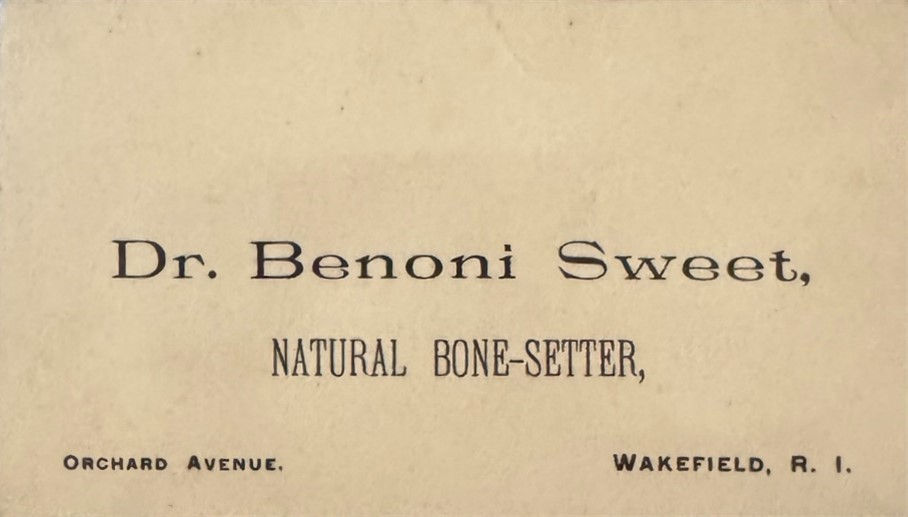
Business card of Benoni Sweet, (about 1900). He had been a stone mason by trade for decades, but upon the 1893 death of his bone setting brother, George, Benoni took up the family’s calcified baton and continued on as a natural bonesetter until his death in 1922. On the day he died, Benoni reset the fracture of a boy’s wrist. (Rapoza collection.)
     Another distinguishing feature of the early American bonesetters besides their training from seasoned bonesetters within their own family was that they downplayed their skill; bonesetters from the Sweet family, for example, rarely advertised their services until the late Victorian era. Benoni Sweet (ca.1812) was a blacksmith. Waterman Sweet (ca.1830) placed an ad that mentioned he was a Bone Setter, but the central thrust of his ad was about “a lot of good Butter for sale” at his new shop in Providence. When bonesetter Stephen Sweet (ca.1843) was sought out by a newspaper correspondent for his special skills, he was found “industriously at work with his scythe in a field.” Neither he nor his equally sought-after bonesetter father published accounts of any of their remarkable cures nor even maintained a private list of the most difficult cases and when the writer was introduced to Stephen Sweet’s “troop of children,” he found that some were already beginning to prove themselves in the work of bonesetting.
 
THE PIONEERING MRS. DR . RYDER

     Elmina Eusebia Chase emerged early from the home of her youth in Athens. She was a bride at 16 years old, having married a self-made healer named Ransellear Chillson, who was 21 years old; two and a half weeks later, she gave birth to their first child in Andover, about 19 miles from her childhood home.

     In the next three years she had two more children. At about this time, when the 19-year-old mother was pregnant with her second, she began practicing as a physician. Why she began at this point in time is unknown; perhaps it was financial necessity compounded by an extended illness of her husband. He died in 1848, three years after she had borne him their third child. Consequently she was, at 26 years old, a widow and single mother of three children under 10 years old. She had also lost her beloved mother and mentor in 1846 and two of her brothers: Isaac, the homeopath, and Ebenezer Jr., the Indian root doctor. With her husband gone and a big chunk of the family that had been her world for sixteen years, Elmina had to survive on her own and protect her young cubs in the Vermont wilderness.

     In the midst of the staggering losses of her husband, mother, and brothers, Elmina did more than just rebuild her life by putting herself out there as a physician. With inspiring fortitude and determination, she attended classes at the Woodstock Medical School sometime between 1846-1850, about six miles away from her Bridgewater lodgings. She joined other area residents who attended classes at the school in “the basic natural sciences” (chemistry, geology, botany, zoology, etc.) Women weren’t allowed to attain a medical degree there before 1850, plus she was raising her children alone and beginning to work as a physician, so her limited time at the school was to improve her knowledge generally and in some aspects of her new profession (perhaps in chemistry and botany), even though she wouldn’t be able to get a degree as a result of her efforts. Elmina remarried to James Ryder late in 1850 and they moved to Randolph, Vermont, another 33 miles and several covered bridges further north into Vermont’s woods.

     When the newly married couple and blended family reestablished themselves in Randolph, husband James redirected his career path onto a similar trajectory as his bride; he put away the hoe and for a time worked in a drug store as its clerk and he “also became known as a manufacturer of medical preparations" (perhaps he assisted his wife by preparing her medicines, like the Frost and Fire Ointment). All was not family harmony and optimism during the several transitions they were making; less than a year later, James posted a notice in the newspaper that his stepson, Elmina’s oldest boy, a 15-year-old minor “who has been under my care, has left my charge without a cause”; so he put all on notice that he wasn’t going to pay any bills that his wayward stepson may incur. Like the bones Elmina reset, the relocations of home and family caused some pains before the healing could begin.
 
MOTHER, WIFE, BONESETTER, PHYSICIAN

     In short order, Elmina’s three Chilson children left the familial nest over the next decade by skedaddling at fifteen, marrying at sixteen, and dying at thirteen; but the losses were replaced with another brood during her second marriage, in 1853, 1857, and 1862. No details of her medical career appeared during these years that she was delivering and nurturing her second family, but soon thereafter Elmina’s healing works blossomed in print. Her husband’s service in the Civil War (for which he was registered as a physician) also contributed to her increased attention to home and family. She had been practicing medicine for some twenty years, but it took a back seat to her role as mother.

     When James returned from the war, Elmina emerged again in an active and accelerated role as a physician. In 1863 James had paid the license tax for being a physician, but in 1864 it was Elmina who was charged with the physician’s tax. She gave medical exams to veterans applying for pension increases due to wartime wounds and disabilities. In 1868 she reported that she had been doctoring one such veteran, George W. Badger, for years because he was

… laboring under a chronic disease of the Liver and Kidneys. Effecting the Spinal column and heart. producing palpitation and other diseases which wholy [sic] prevent his performing any labor … sufficient to sustain himself. … I have prescribed for the said [Geo. W.] Badger for the last 5 or 6 years and I don’t discover that he is e[n]joying no better health at this time than he was at the time that I first prescribed for him. I think that his disorders are such that he cannot be cured and made a healthy man

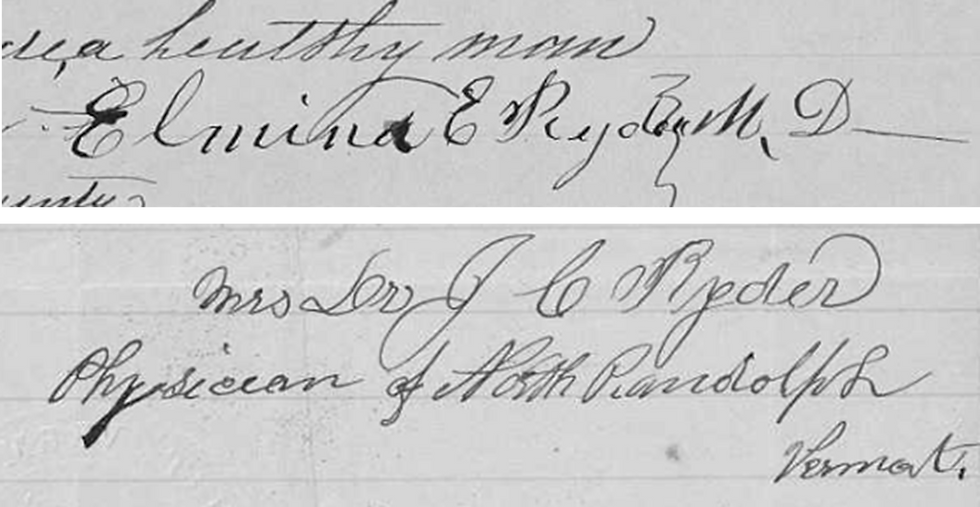
     She signed her medical testimonies “Elmina E. Ryder M.D.” and “Mrs. Dr. J. C. Ryder / Physician of North Randolph.” The Justice of the Peace certifying the documents stated that she was “a physician respectable and reputable in her Practice.” Later that same year she filed her own claim due to her husband’s disability.
 
Signatures of Mrs. Dr. Elmina Eusebia Ryder. Certificate of Disability for Discharge of George W. Badger, (TOP) Image 727, dated 17 NOV 1868; (BOTTOM) Image 729, dated 7 SEP 1868. Courtesy of FamilySearch.org.
     Badger, her sickly veteran patient, resided in Sharon, Vermont, some 19 miles from North Randolph, and she made many trips there to doctor him over the space of a half dozen years. She again appeared in the newspaper for providing medical aid to a schoolteacher in Woodstock, about 28 miles from her home, and when she tried to collect on her debts from the estate of a deceased patient in Hartland, 40 miles away. Her reputation was her advance agent and reminiscent of her mother; her whereabouts were being monitored for the public in the newspapers. As late as 1878, at the age of 56, she was located 34 miles from home, doctoring and apparently even doing some teaching, perhaps providing private lectures for women on health topics as was popular in that day: “Mrs. Dr. Ryder is out of town practicing most of the time this season. ‘Mina’ has been at White River Junction for some time, teaching, but is at home now.” 

     Perhaps her out-of-town medical travels gave her youngest son the opportunity for criminal mischief; at 16 years old, “Cash” (Cassius) Ryder was one of three rowdies who were arrested for disturbing the peace in the village of North Randolph one August night in 1878 when they “commenced depredations” on several others, “without any cause whatever.” On the other hand, when James, the oldest son from her second marriage, was 16 years old, he began assisting his mother in her professional labors. He went on to become an eclectic physician after attending the University of Pennsylvania in 1874 and doing some residency work at Bellevue Hospital in New York, in 1875; despite his formal training, he followed the example of his mother and made a specialty of the treatment of dislocations and fracture. Bonesetting had been passed down one more branch of the Chase family tree.

     Bonesetting was a unique system of healing that required skillful, experienced hands and a strong knowledge of skeletal arrangement and required no medicine to perform the relocation of joints or resetting of bones; however, it was common for the bonesetters to have their own topical medicines to reduce inflammation and swelling, relax stiff muscles, quell pain, and return circulation to numbed limbs. In 1817-1818, Robert Hewes of Boston offered Hewes’ Nerve Ointment and in the early 1860s Stephen Sweet made his Dr. Sweet’s Infallible Liniment.

 THE BONESETTER’S CURE FOR FROST AND FIRE

     Mrs. Dr. Ryder also had her own topical product – Frost and Fire Ointment – that wonderful bottle that got away from me at the auction. The label of the small, twelve-sided bottle described the ointment inside as “unsarpassed [sic] for the cure of Burns, Scalds, Freezes and Chilblains, also old ulcerated sores.” “Frost” was the creative description of frostbite and chilled body parts it promised to cure and “Fire” referred to burns and scalds. The medicine’s name is creative genius, applying the opposite temperature extremes in one product name to constantly call to mind the totality of its healing benefits. The medicine had high viscosity, so the label instructed that the ointment needed to be warmed by the fire. Remnants of the thick ointment still coat the bottle’s neck, resolutely unmoved by the passage of time. The label on the auctioned bottle also has handwriting that crossed out the frequency of application in the printed instruction, “to be used once or twice a day,” replaced by “to be used at night.” More handwriting along the label’s top edge repeats the advice, “use at night.” The handwriting was definitely Mrs. Dr. Ryder’s (when compared to the letters she wrote as the examining physician for Badger’s disability petition). It was a personal touch, important enough to her to correct its use for the benefit of the patient; using it once instead of twice a day meant one bottle would last twice as long – clearly an instruction of a physician who was putting the patient before profit.

LEFT VIEW OF LABEL – Frost and Fire Ointment, prepared by Mrs. Dr. Ryder, North Randolph Vermont (about 1855-1865). View of the left side of the label that wraps completely around the bottle. Aqua, unembossed, smooth-based, 12-sided jar, height: 3 1/8"  (7.9375 cm). It had an extra-wide neck to get out the viscous contents as needed.  The 50-cent price ($18.62 in 2025 USD) was a considerable expense; the medicine had to deliver on its promises to justify the significant cost.  Courtesy of John Pastor, American Glass Gallery.
LEFT VIEW OF LABEL – Frost and Fire Ointment, prepared by Mrs. Dr. Ryder, North Randolph Vermont (about 1855-1865). View of the left side of the label that wraps completely around the bottle. Aqua, unembossed, smooth-based, 12-sided jar, height: 3 1/8" (7.9375 cm). It had an extra-wide neck to get out the viscous contents as needed.  The 50-cent price ($18.62 in 2025 USD) was a considerable expense; the medicine had to deliver on its promises to justify the significant cost. Courtesy of John Pastor, American Glass Gallery.
RIGHT VIEW OF LABEL – Frost and Fire Ointment, prepared by Mrs. Dr. Ryder, North Randolph Vermont (about 1855-1865). View of the right side of the label that wraps completely around the bottle. Courtesy of John Pastor, American Glass Gallery.
VIEW OF FULL LABEL - Frost and Fire Ointment, prepared by Mrs. Dr. Ryder, North Randolph Vermont (about 1855-1865). Complete label view, digitally reconstructed from the fully rotated bottle. Courtesy of John Pastor, American Glass Gallery.

BONES SET AND FRACTURED

     A patient’s desperation and the physician’s reputation combined to create demand for medical services and products. Elmina Eusebia Chase, aka Mrs. Dr. Ryder, was the female bonesetting prodigy of the Chase family and, like her mother, she traveled up and down the Vermont countryside gathering a notoriety among those who experienced or knew of her unusual skillset.

     Elmina used her bonesetting talents along with other healing techniques that she had learned around the Chase family’s cast iron stove and bedside. She was consequently sought out for her broad range of skills, as demonstrated by a very sick Sylvester Thurston in 1870. Sick at his West Braintree home for about two months, his anxiety continued to escalate as his health steadily decreased. A legion of friends and physicians advised him to try all manner of remedies and healing methods but all were to no avail. Within a few weeks of his death

… he became discouraged and was almost frantic at times with the idea that he should never get well. Fearing that insanity would be the result of such a state of mind, he was persuaded to spend a few weeks at Mr. Ryder’s, in North Randolph… Said he, “if Mrs. Ryder cures me I shall think she can almost raise the dead.

     But even Mrs. Dr. Ryder couldn’t perform miracles and the desperately unhinged patient took his own life.

     There were plenty who wanted irregular healers to fail and Mrs. Dr. Ryder was an exemplar of everything wrong with irregulars – she was a woman; one of those strange bonesetters; a female scandalously daring to treat males among her patients; and a healer practicing medicine without a degree or license. Every failed diagnosis, treatment, or prescription was potentially hazardous to her reputation; every misstep could bring a big fall. On one occasion she tried to reset the foot of a man who had injured it by jumping off an out-of-control wagon in motion; pulling on his foot, however, just made the pain worse. In 1870 a lawsuit was leveled against Mrs. Dr. Ryder when a disgruntled former patient sued Elmina and her husband for her malpractice in setting the shoulder of the plaintiff. The jury returned a verdict in favor of the plaintiff for $600 ($17,312 in 2025 USD) in damages plus court costs. In 1877 she was arrested along with a few others for allegedly performing an abortion that also resulted in the pregnant woman’s death; fortunately for Elmina, two of the others were held for trial but the prosecutors decided they would not pursue the prosecution of Mrs. Dr. Ryder.

     The favorable reports about the practice and personality of the female bonesetter were more frequent and consistent that the negative ones. In late January 1876, the Green Mountain Freeman  reported that a woman in Brookfield fell down the cellar stairs and was in very critical condition, not expected to recover. In early February the newspaper followed up that Mrs. Dr. Ryder was called upon to make an examination of the fall victim’s injuries “and endeavored to set the bones of her dislocated wrist. Her recovery, considering her age and the amount of injury sustained, is marvelous.”

     When Elmina passed in 1881, her obituary gave a glowing tribute to the life, career, and character of the unusual bonesetter from Athens, Vermont. Like her father and mother, she had earned widespread admiration:  

You can go into hardly a town in this State where she is not known. She has many who regarded her with feelings of gratitude and love for the valuable medical service she has rendered them. She has given permanent help to many patients who had received treatment from others with no good results. Few physicians have endured more exposure to storm and rain, heat and cold.  … [she was a] faithful wife and kind mother …

     Two years before her death, she also got an endorsement from a stranger who recognized that her good deed was the sign of a rare individual of quality:  

A. C. Hitchcock, a few days since, while on his way from St. Albans to Waterbury, on the cars, lost his pocket book containing a sum of money, and a $100 note. Since his return, a lady from Randolph has written him that she is the finder thereof. Mr. Hitchcock writes that this was Mrs. Dr. Ryder, a lady whom he had never seen or heard of before, and he thinks that in these days when dishonesty stalks abroad so defiantly, an honest person, man or woman, should be made known to the public.”

     It would clearly be considered an extraordinary act of integrity in 2025 as much as it was in 1879. Everything about Mrs. Dr. Elmina Eusebia Ryder makes me wish I could have met her, but then again, researching every available fact about her life has made me feel like I have gotten to know her very well. One additional phrase in her obituary resonated with me for its unique expression and symbolism: “her memory will be fragrant through all the years to come. …” What a beautiful phrase of heartfelt praise.
 
SUMMARY

     Bonesetters are the unicorns or leprechauns of American healing history; so little is known about the few, unassuming bonesetters, they almost feel like the stuff of legend. Many irregular medical methods and systems were being heavily promoted, especially in the 19th century, but bonesetters were discovered, not advertised. They might be your blacksmith or grocer or botanic physician who suddenly offered to reset your dislocated limb, then would go back to making your horseshoe or selling you some butter when they were done. Some of the bonesetters did begin advertising late in the century, but they were the exception to the rule. That elusive little auction treasure of Frost and Fire Ointment revealed Vermont’s obscure Chase family of bonesetters and the little-known world of bonesetting during some anxious auction hours and once more in this blog post.  For a few minutes today you’ve caught the elusive golden snitch of American medicine. Congratulations – it’s a rare victory.

Lynn Massachusetts history - History of medicine - 19th-Century Health Remedies - Vintage Medical Ephemera - 19th-century medicine


Updated: Nov 28, 2025

Pain Attacks. The first of a two-part “before-and-after” advertisement for Wolcott's Instant Pain Annihilator aka Wolcott’s Pain Paint. Created by: W. Endicott & Co., about 1863. Library of Congress; Museum No. LC-USZC2-36.
PAIN. Throbbing, stabbing, aching, distracting, excruciating, agonizing, unbearable PAIN.

Hannibal Lecter and S&M enthusiasts aside, most people don’t like pain. We’ll do just about anything we can to avoid it and when it does happen to us, we’ll do everything we can think of to get rid of it, as quickly as possible.

A toothache; a hangnail; a sprained ankle; a leg cramp; a migraine headache – every pain is one we want to have go away. You, me, and every one of our ancestors have tried almost everything to get rid of pain quickly. Sometimes what we try defies logic – and almost certainly flies in the face of science – but for thousands of years, in moments of excruciating pain, we have turned to methods and cures that win our praise if the pain goes away. That has often been the sole measure, whether it’s with two Advil pills today or a teaspoon of Wolcott’s Pain Paint over a century ago. When pain hits, our animal instinct just wants it to stop and the method, be it scientific or magical, really doesn’t matter. Be honest with yourself – you probably couldn’t explain the chemistry and active ingredients of Tylenol any better than your Victorian forebears could with Dr. William’s Pink Pills for Pale People.

      The image above shows a Victorian era man plagued by a legion of demons in full attack mode, causing his headaches, sinus pain, toothaches, neuralgia, and more. To his right, the Grim Reaper emerges from his fog-shrouded netherworld, looking pleased at the pain being inflicted by his minions. In the same primal way that such imagery symbolically described their pain, Victorians also wrapped their aching heads around the idea that pain could be cured by magic.

Bartmann Bottle, about 1650. At its base is a modern recreation of typical “witch bottle” contents: nails, a fabric heart pierced by bent pins, and human hair with fingernail clippings. Rapoza collection.
      Such a belief was likely passed down to them by old-timers in their lives who insisted that a special home-made medicine had to be swallowed during the waning of the moon or who still hung a horseshoe on their door. My own grandmother winced as she told me how her grandfather made his own medicinal tea from rat droppings because he distrusted doctors so much; he may have thought it was a magical brew but my grandmother thought he was full of crap.

      America has a long history of reliance on magic and superstition to influence our behavior. Today’s post offers just a few examples for you to steep in your cauldron of possibilities for the next time your body screams at you, “I’M IN PAIN!”
     
Colonial Magic

As I shared with you in my post, “Weaponized Witch Bottles” (10 AUG 2024), colonists in North America relied on biblical passages that warned against the evils of witchcraft. They turned their empty wine and beer jugs into weapons to protect against the attacks of witches and their familiars, especially to protect the sick in their families. They further strengthened their defenses by hanging a horseshoe outside their door and making ritual protection marks around their doors, windows, and fireplaces – all the possible entry points for evil spirits to enter the home. Even biblically-inspired numerology was taken seriously: a braid of 12 garlic bulbs (symbolic of the 12 apostles) hanging behind the door was believed to prevent witches from entering the house; just 11 bulbs was nothing more than a bunch of smelly vegetables hanging on the door.

It was a time when magic was medicine and superstition dominated in the absence of science.
 
Victorian Magic

      Two hundred years after the Salem witch trials, well after the colonies had merged into the United States of America, the country had survived its Civil War and two wars with England, and it leapfrogged into an era of electricity, telephones, x-rays, anesthesia, vaccines, blood transfusions, and the discovery that germs cause disease. Amid all this growth, modernization, and sophistication, it might seem like there was no longer a need for superstition and magic.
Magical Medicine from the Mystical Kingdom. The Egyptian theme of Colwell's medicine tied in perfectly with its promise of magic. The eye-catching trademark featured the bizarre Sphinx above and baffling Egyptian heiroglyphics flanking the word MAGIC. The Egyptian-inspired trademark hinted at the mysterious origins of the magical cure. There was absolutely no effort to ensure scientific efficacy. (Library of Congress: Trade Mark No. 10,302, registered 22 MAY 1883)

If that’s what you’d choose to believe, you have chosen … poorly.

      Pain and disease had not been eliminated and science and medicine still had a long way to go. People were still having headaches and toothaches, rheumatism and sprains, and a bottle or box of medicine still offered low-cost, high-promise alternatives to doctors and dentists. 

      The absence of regulation in the medical marketplace meant medicine makers didn’t have to reveal the contents of their products and it’s fascinating how often they chose to claim their cure was  MAGIC – far too many to list them all here, but a few examples were:

  • Bennet’s Magic Cure
  • Dr. Colwell’s Magic Egyptian Oil
  • Fink’s Magic Oil
  • Van’s Magic Oil – None other than a customer named Mrs. A. Pain wrote to the manufacturer, “We will never employ a doctor for cold or diphtheria while we can get your Magic Oil.”
  • Dr. Horbson's Magic Oil
  • Dalley’s Magical Pain Extractor
  • Dr. Hardy’s Magical Pain Destroyer
 
Dr. Hardy's Magical Pain Destroyer (box & bottle), about 1885. It's hard to believe that Dr. Hardy's brooding face could encourage any confidence in the success of his medicine. It was likely a rendering from some early form of photography that required expressionless faces so the result of the slow shutter speed would not be fuzzy. But come on, Dr. Hardy - crack a smile! It's not magic! Courtesy of Sheaff-Ephemera.com
Dr. Hardy's Magical Pain Destroyer (label on interior counter display box lid), about 1885. Courtesy of Sheaff-Ephemera.com

      One look below at the Victorian poster for Renne’s Pain Killing Magic Oil vividly reminds us of how much we hate to hurt. His puffy eyes are almost squeezed shut; a large tear streams out of the corner; his lips look aquiver in misery. The head bandage under his jaw was usually a symbol of tooth pain, but this pathetic soul is also holding his stomach, apparently yet another locus of pain. We empathize with our young friend – we feel his pain.

      Miserable in pain and apparent low on funds with a patched and tattered jacket, the young chap stands dumfounded in front of a drug store full of Renne’s Pain Killing Magic Oil; it’s frankly hard to tell if we are supposed to be witnessing that magical moment when he realized he had just found the cure for his woes or if his tear is because he couldn’t afford to buy the magical painkiller. Either way, he clearly wants some magic in his hard-luck life.

Renne's Pain Killing Magic Oil (bottle & poster, about 1885). Bottle courtesy of Library of Congress. Poster courtesy of Wm Morford Antiques, AntiqueAdvertising.com

      Notice that on the bottle, above the picture of Mr. Renne, was the magical medicine’s slogan, “IT WORKS LIKE A CHARM”; some newspaper ads for assured that its effect was “very magical.” It was, of course, a great word to hide behind, since the public were not invited to know the ingredients and proportions being used in the medicine. Medicines not promising magical results hid behind other fanciful names, such as Dr. Kilmer’s Swamp Root Kidney, Liver, & Bladder Cure, Pocahontas Barrel Bitters, and Smith’s Bile Beans. But “Magic” was more than a just camouflage; it was also a promise of potency and results even though sick customers had no idea why it would work for them. Subconsciously, people who enjoy magic shows want to be deceived. It fills us with wonder and awe and lets us believe that the world is full of unexplainable things. Magic gives us hope there are answers for problems and pains we could not solve ourselves.

      Anyone who collects antique medicines knows that patent medicines had all sorts of names; those promising to stop pain weren’t limited to names implying magical ingredients. Perhaps the biggest selling pain cure of the century was the magic-free Perry Davis’ Pain Killer. Another example is from my own collection, Thurston’s XXX Death to Pain. Not only did its name promise to be the death of pain, but the triple “X” meant triple-strength – no indication of what, but it certainly sounded powerful!

Thurston's XXX Death to Pain (box & bottle, about 1890). Rapoza collection

      Similar to the magic cures was a smaller subset of medicines called “mystic”. The name of Dr. I. A. Detchon’s Mystic Cure made it clear that the contents transcended human understanding and were somehow connected to ancient and perhaps occult mysteries. One of its ads explained that “Its action upon the system is remarkable and mysterious.” - take it, just don’t try to understand it.

      Note that the bottle label explains that the Mystic Cure should only be used in combination with the Mystic Life Renewer.

Detchon's Mystic Cure (box & bottle, about 1885). Rapoza collection.

Newspaper advertisement for Mrs. Wilson's Mystic Pills by the Gray Medicine Co., Toronto, Canada.The Daily Expositor (Brantford, Ontario), 2 OCT 1880.
      Mrs. Wilson’s Mystic Pills from Toronto, Canada, was the perfect name for a medicine designed for the many diseases and disfunctions of the mysterious female reproductive system. The title implied secrecy, the dark closet in which many high-strung Victorians wanted to have the subject hidden. The trademark shows the female angel holding a box of the medicine in her right hand and her left hand pointing to the banner that displayed the “Mystic Pills” part of the name. An enlargement of the knuckles actually suggests the angel may be using the middle finger, but let’s just say it's the index finger!

      For at least some of the many late-19th century remedies, the evocative words “Magic,” “Magical,” “Mystic,” or “Mystical,” in their name were used as more than just convenient marketing adjectives; they were designed to attract those customers who continued to harbor the centuries-old beliefs in magical potions, hoodoo, astrology, charms, and promises of good luck and fortune. The reason so many medicines seemed magical in their result was most likely due to the active ingredient (besides alcohol): opium, morphine, cocaine, or cannabis - they were each dangerous in excess but truly potent and successful in temporarily diminishing or eliminating pain.

Columbia believes in Magic. This Civil War-era newspaper advertisement for Weeks' Magic Compound invokes the patriotism of Columbia herself. The manufacturer was E. B. Magoon & Co. of North Troy, VT, 1862.
      Of course each era has also had its critics. Just like there were colonists who insisted there was no such thing as witchcraft, magic and mysticism had its detractors in the Victoria era. In 1900, Missouri’s Joplin News-Herald complained bitterly that “Americans are still believers in magic …” The newspaper pointed to a single factory of “magical devices” and found that it produced crystal balls and “not less than 5,000 divining rods and many other similar contrivances which are supposed to have the virtue of locating gold mines or hidden treasure.” – and the newspaper was disgusted that gullible fools would spend their money on things supposedly imbued with magic:

For one of these treasure indicators a farmer will pay from $15 to $35, and then, neglecting his toil, firm in the conviction that he has a truly magical device that will bring him untold wealth, he will tramp for days and even weeks over the old fields he had farmed since boyhood, seeking the gold mines and buried treasure the “magician” has assured him is there.

      Medicines made in the name of “Magic” were another clear evidence of a portion of the population still hanging on to remedies emanating from the occult universe. In fact, even as the new Food and Drug Administration clamped down on specious patent medicines, magic oils and the like lingered, defiantly, deep into the 20th century.
     
Digital Magic

      So now, dear readers, we sit in front of the screens of our cell phones and computers, reflecting a little smugly at the centuries of Americans who have believed in and resorted to magic, luck, and the mystical. But while our country may have continued its forward march in medicine, science, and technology, we are clearly far from giving up our superstitions and symbolic acts for warding off evil, eliminating physical and emotional pain, and encouraging good “mojo.”

      Many doctors still administer placebos and patients often believe those harmless pills have made them feel better. Copper bracelets have never been proven to improve health, but many swear by them, nonetheless. (No offense intended to the placebo or copper bracelet manufacturers.) Family, friends, co-workers, and sometimes even strangers will say “bless you” after you sneeze, to ward off illness. And lots of Americans still act out in similarly irrational behavior today to improve, protect, and bring comfort to other areas of their lives in the midst of an often harsh and painful world:

  • Since 1952, fans of the NHL hockey team, the Detroit Red Wings, have thrown a dead octopus on the ice for “good luck” in the playoffs, despite the fact that the team has won only 7 Stanley Cups in the 73 years that octopi carcasses have slid across the Detroit ice. Oh, and catfish are similarly tossed onto the ice to invoke good luck for the Nashville team, and plastic rats keep getting flung into a hockey rink just north of Miami after a player killed a rat in the locker room with his hockey stick before the game and then scored two goals with that stick.

  • After you eat your Chinese food, do you throw away the fortune cookie or do you open it to see what the fortune says? (… And does the rare fortune that promises, “Great wealth is coming your way,” get quietly tucked into your pocket?)

  • Do you save the turkey wishbone to engage in a little post-Thanksgiving tugging match for luck?

  • Have you noticed that tall buildings usually have no 13th floor selection in the elevator? The architects and engineers didn’t forget how to count.

  • For the last 51 years, Lucky Charms cereal has featured marshmallow bits in the shape of such luck-laden symbols as blue moons, four-leaf clovers, and horseshoes. (My guess is that witches can’t eat that cereal.)

      We may not have been comfortable living in Colonial or Victorian America, but they would probably feel right at home in home here. Our modern world might be full of advanced knowledge but pain still haunts us all and hope for magical improvements still ripple through our souls.

Pain Vanquished. This is the second of a two-part “before-and-after” advertisement for Wolcott's Instant Pain Annihilator aka Wolcott’s Pain Paint. Created by: W. Endicott & Co., about 1863. Courtesy Library of Congress; Museum No. LC-USZC2-36.


bottom of page